Post Published on October 26, 2026
Discovering that your dog has a Cranial Cruciate Ligament (CCL) injury is tough for any pet parent. If you chose a conservative management path—opting out of both invasive surgery and external orthopedic bracing—you likely hoped that strict rest and time would allow the knee to heal on its own.
However, If your dog is still limping months after a CCL injury, favoring the leg, or experiencing “start-up stiffness” after resting, you are probably wondering what went wrong.
The truth is, while a dog’s body is incredibly resilient, a CCL injury fundamentally changes how the knee joint functions. Here is a look at the physiological reasons why your dog isn’t improving, and what you can do to get them back on track.
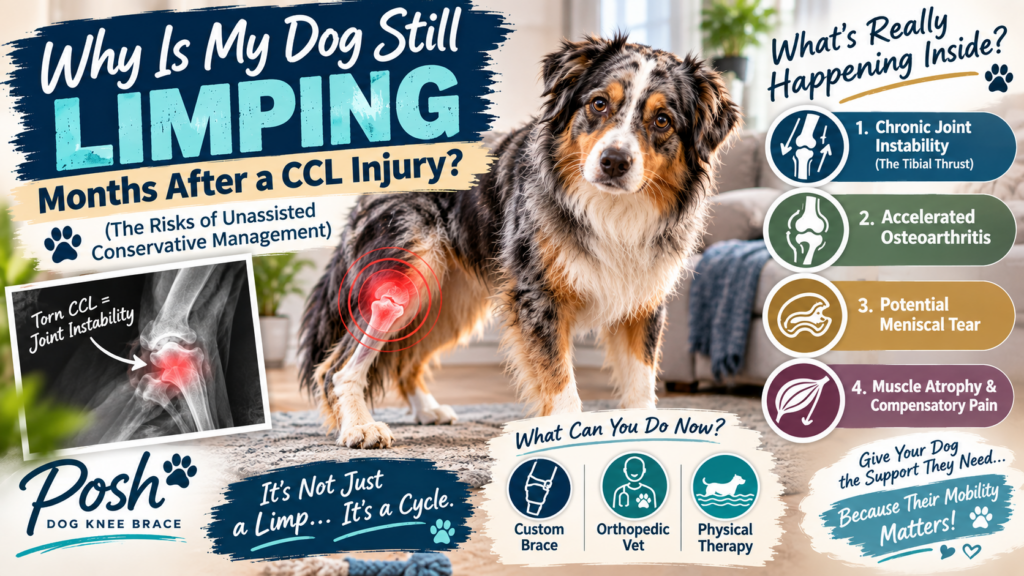
The primary job of the CCL is to act like a seatbelt, stopping the shinbone (tibia) from sliding forward out from underneath the thighbone (femur) whenever your dog puts weight on the leg.
When the ligament is torn or severely stretched, this structural “seatbelt” is gone. Without surgery to alter the bone shape or a custom rigid brace to mimic the ligament, every single step your dog takes causes the bones to grind out of alignment. This continuous mechanical slipping, known as cranial tibial thrust, prevents the joint from ever truly stabilizing or healing.
Because the joint is unstable and grinding with every step, the protective cartilage cushioning the knee wears down at an alarming rate.
What started as a ligament tear quickly develops into severe, chronic osteoarthritis. Months after the initial injury, the primary source of your dog’s ongoing limp might no longer be just the torn ligament, but rather the painful, permanent bone-on-bone friction and joint inflammation caused by secondary arthritis.
Inside your dog’s knee sits the meniscus—a C-shaped piece of cartilage that acts as a shock absorber. When a CCL is torn and the joint is left unstable without a brace or surgery to hold it in place, the constant forward-and-backward slipping of the bones frequently pinches, crushes, or tears the meniscus.
A meniscal tear is incredibly painful (often described as walking with a sharp stone in your shoe) and will cause a persistent, severe limp that won’t go away with simple rest.
When a dog’s knee hurts, they naturally shift their weight away from it. Over several months, this causes two distinct physical issues:
Absolutely not. If conservative management through crate rest alone has failed, and your dog is still limping months after a CCL injury, it simply means your dog’s knee requires structural support to heal.
The Bottom Line: Conservative management can be highly successful, but it rarely works by rest alone. Without surgery or a rigid brace to stabilize the joint mechanics, the knee remains in a constant loop of inflammation and micro-injury.Providing your dog with the structural support they need — even when they’re still limping months after a CCL injury — can dramatically alter their healing trajectory and restore their quality of life. Check out our Facebook page as well.
Articles from the Posh Dog Knee Brace team — a group effort with our licensed veterinary technicians and brace specialists, sharing 15+ years of experience helping dogs recover from CCL/ACL injuries and mobility challenges.