Post Published on October 19, 2026
Your dog’s muscle mass is the biggest predictor of how well they’ll recover from a CCL injury. When a dog suffers a Cranial Cruciate Ligament (CCL) injury, pet parents naturally focus entirely on the knee joint itself—the torn ligament, the bone alignment, or the surgical hardware.
However, orthopedic surgeons and canine physical therapists look at something completely different to determine how well a dog will heal: thigh muscle mass.
Whether you choose surgery, a custom brace, or conservative management, your dog’s muscles are the ultimate shock absorbers for the joint. Here is why building and preserving muscle mass is the absolute key to a successful CCL recovery.
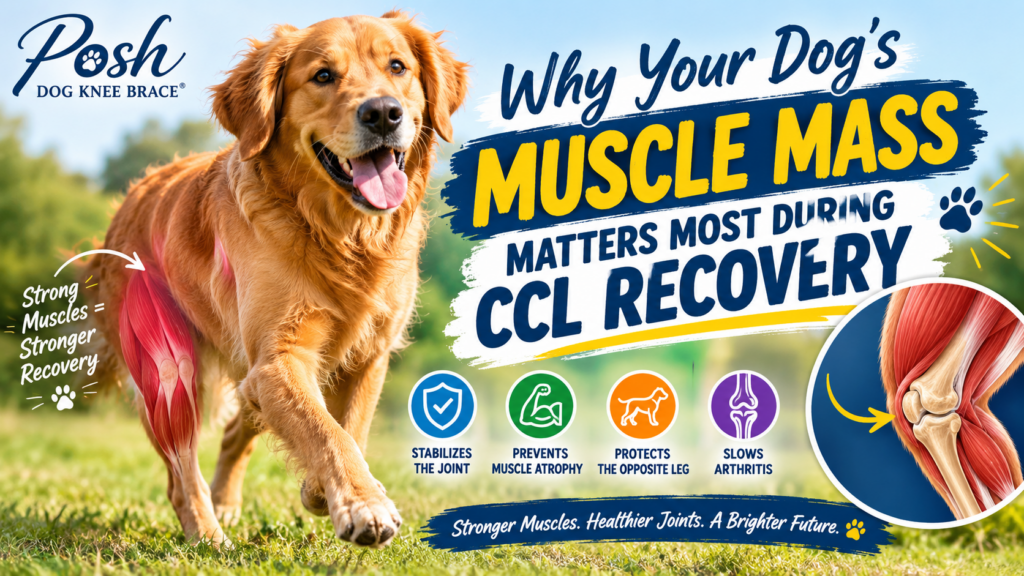
The CCL’s job is to act like a seatbelt, stopping the shinbone from sliding out from underneath the thighbone. When that ligament is damaged, the mechanical stability is lost.
This is where the quadriceps and hamstring muscles come to the rescue. When these powerful leg muscles are thick, strong, and well-conditioned, they act as an active, living brace around the knee. Strong muscles contract to clamp the joint in place, severely reducing the painful grinding (tibial thrust) that happens every time your dog takes a step.
The moment a dog injures their knee, they naturally stop putting full weight on it. Within just two to three weeks of favoring a leg, rapid muscle wasting (atrophy) begins.
This creates a dangerous downward spiral:
Breaking this cycle early by safely engaging the muscles is crucial for your dog’s long-term mobility.
As mentioned in previous articles, up to 60% of dogs will tear the CCL in their opposite leg within a year or two of the first injury.
Why? Because when a dog loses muscle mass and function in the injured hind leg, they aggressively shift their body weight forward and onto the opposite good knee. If you can preserve and rebuild the muscle mass in the injured leg quickly, your dog will return to a balanced, symmetrical gait much faster, saving the remaining healthy knee from catastrophic overload.
Every dog with a CCL injury will experience some degree of arthritis. However, dogs with excellent muscle mass experience significantly slower arthritis progression. Strong muscles absorb the concussive shock of walking and running. If the muscles are weak, that raw, heavy impact forces its way directly into the bone surfaces and cartilage, accelerating joint wear, inflammation, and chronic pain.
You cannot simply take a recovering dog out for a run to build muscle; high-impact twisting and sprinting will ruin their recovery. Muscle building post-CCL injury must be low-impact and controlled:
Utilize a Custom Rigid Brace: If you are navigating recovery without surgery, a custom device like the Posh Dog Knee Brace holds the bones in alignment, giving your dog the immediate confidence to stand squarely on the leg. This weight-bearing allows them to build active muscle mass during daily walks instead of letting the leg waste away.
The Bottom Line: A knee joint is only as strong as the engine driving it. By focusing heavily on preserving and rebuilding your dog’s thigh muscle mass through targeted, safe exercises, you aren’t just healing a ligament — you are bulletproofing their entire lower body against future injury. Come visit us on Facebook too, where we share daily recovery tips and success stories from dogs just like yours: facebook.com/poshdogkneebrace
Articles from the Posh Dog Knee Brace team — a group effort with our licensed veterinary technicians and brace specialists, sharing 15+ years of experience helping dogs recover from CCL/ACL injuries and mobility challenges.