Watching a beloved dog slow down due to joint pain is incredibly difficult for any pet parent. When arthritis hits their knees (the stifle joints), even simple tasks like standing up after a nap or going for a short walk can cause noticeable limping and distress.
If you are looking for non-surgical ways to manage your dog’s pain, you might have wondered: Can a knee brace really help with canine arthritis?
The short answer is yes, a properly designed orthopedic brace can provide significant relief. Let’s dive into how bracing helps arthritic joints and specifically examine how the Posh Dog Knee Brace addresses this painful condition.
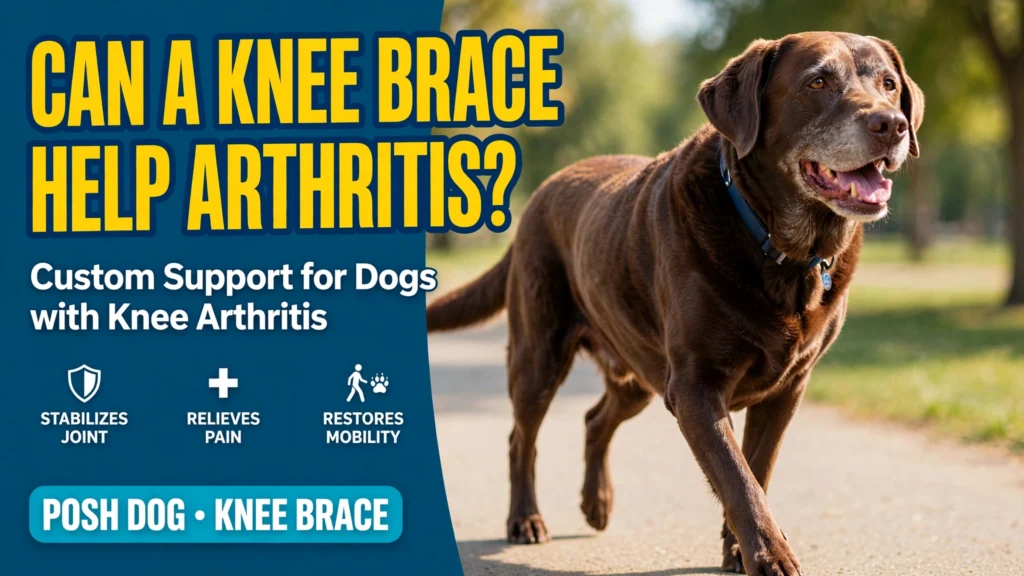
Arthritis involves chronic inflammation and the gradual breakdown of protective cartilage inside the joint. When a dog moves an arthritic knee, instability causes the joint to grind awkwardly, leading to pain, swelling, and further wear and tear.
An orthopedic dog knee brace targets these issues by providing three main benefits:
While many fabric or wrap-style braces on the market simply stretch and fail to restrict bad joint motion, the Posh Dog Knee Brace is a custom-made, rigid orthopedic device built to address joint structural issues.
Originally engineered as a highly effective non-surgical alternative for Cranial Cruciate Ligament (CCL/ACL) tears, it is frequently used to manage advanced arthritis.
Here is how the Posh Dog Knee Brace specifically aids arthritic dogs:
1. Completely Custom Fit (No Casting Mess)
Generic braces often slip, rub, or fail to apply support exactly where your dog needs it. The Posh Dog Knee Brace is hand-fabricated based on precise measurements of your dog’s leg. Their system utilizes a live video call with a veterinary technician to ensure your measurements are 100% accurate before the brace is made, eliminating the need for complex, messy plaster casting.
2. Targeted Mechanical Decompression
Because it is a rigid custom brace, it acts like a bridge over the knee joint. It takes the direct, heavy pressure off the arthritic surfaces and the meniscus. This targeted decompression is exactly why dogs wearing the brace often go from a severe limp to a comfortable walk almost immediately.
3. Waterproof and Flexible Design
Unlike heavy, restrictive braces, the Posh brace is lightweight, flexible, and waterproof. It allows for a natural walking gait while strictly preventing the harmful, lateral twisting or slipping motions that irritate arthritic joints.
4. Ideal for Conservative Management
If your senior dog has both arthritis and a partial CCL tear but cannot undergo anesthesia due to age, heart conditions, or other health factors, this custom brace is a cornerstone for conservative management protocols. It allows senior dogs to stay active safely without the trauma of a major surgical procedure.
While a high-quality custom brace is an incredible management tool, it is important to remember that a brace does not cure arthritis. It serves as a highly effective management tool to be worn during periods of activity, like walks, backyard playtime, or trips to the park.
For the best results, bracing should be paired with a comprehensive arthritis management plan, including:
The Bottom Line: If your dog suffers from severe knee arthritis—or arthritis compounded by a ligament tear—the Posh Dog Knee Brace offers the structural stability, pressure relief, and pain management needed to dramatically improve their daily quality of life. For more information, contact us through our contact form at https://poshdogkneebrace.com/contact/ or visit us on Facebook at https://www.facebook.com/poshdogkneebrace/
Articles from the Posh Dog Knee Brace team — a group effort with our licensed veterinary technicians and brace specialists, sharing 15+ years of experience helping dogs recover from CCL/ACL injuries and mobility challenges.
Discovering that your dog has a Cranial Cruciate Ligament (CCL) injury is tough for any pet parent. If you chose a conservative management path—opting out of both invasive surgery and external orthopedic bracing—you likely hoped that strict rest and time would allow the knee to heal on its own.
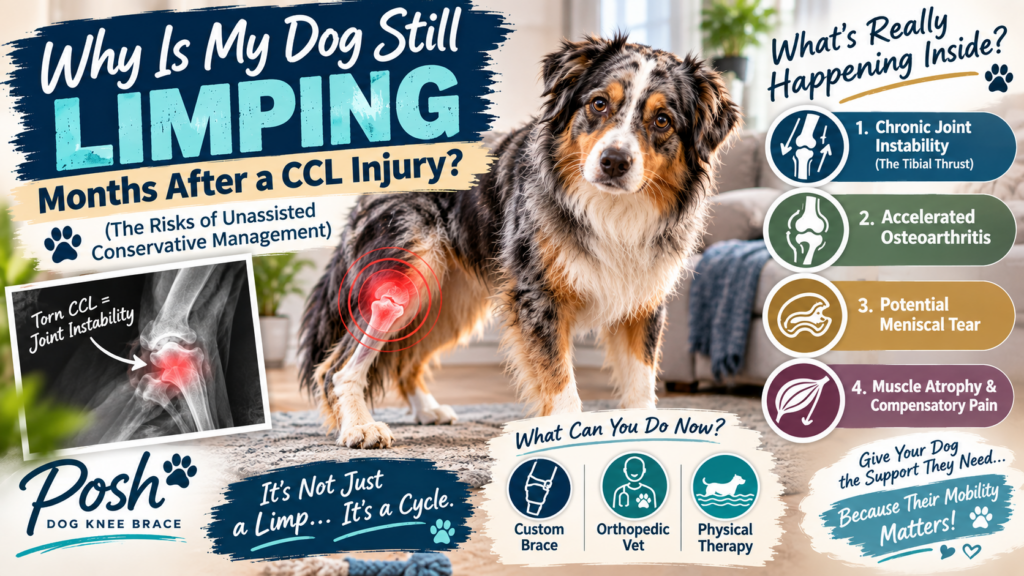
However, If your dog is still limping months after a CCL injury, favoring the leg, or experiencing “start-up stiffness” after resting, you are probably wondering what went wrong.
The truth is, while a dog’s body is incredibly resilient, a CCL injury fundamentally changes how the knee joint functions. Here is a look at the physiological reasons why your dog isn’t improving, and what you can do to get them back on track.
The primary job of the CCL is to act like a seatbelt, stopping the shinbone (tibia) from sliding forward out from underneath the thighbone (femur) whenever your dog puts weight on the leg.
When the ligament is torn or severely stretched, this structural “seatbelt” is gone. Without surgery to alter the bone shape or a custom rigid brace to mimic the ligament, every single step your dog takes causes the bones to grind out of alignment. This continuous mechanical slipping, known as cranial tibial thrust, prevents the joint from ever truly stabilizing or healing.
Because the joint is unstable and grinding with every step, the protective cartilage cushioning the knee wears down at an alarming rate.
What started as a ligament tear quickly develops into severe, chronic osteoarthritis. Months after the initial injury, the primary source of your dog’s ongoing limp might no longer be just the torn ligament, but rather the painful, permanent bone-on-bone friction and joint inflammation caused by secondary arthritis.
Inside your dog’s knee sits the meniscus—a C-shaped piece of cartilage that acts as a shock absorber. When a CCL is torn and the joint is left unstable without a brace or surgery to hold it in place, the constant forward-and-backward slipping of the bones frequently pinches, crushes, or tears the meniscus.
A meniscal tear is incredibly painful (often described as walking with a sharp stone in your shoe) and will cause a persistent, severe limp that won’t go away with simple rest.
When a dog’s knee hurts, they naturally shift their weight away from it. Over several months, this causes two distinct physical issues:
Absolutely not. If conservative management through crate rest alone has failed, and your dog is still limping months after a CCL injury, it simply means your dog’s knee requires structural support to heal.
The Bottom Line: Conservative management can be highly successful, but it rarely works by rest alone. Without surgery or a rigid brace to stabilize the joint mechanics, the knee remains in a constant loop of inflammation and micro-injury.Providing your dog with the structural support they need — even when they’re still limping months after a CCL injury — can dramatically alter their healing trajectory and restore their quality of life. Check out our Facebook page as well.
Articles from the Posh Dog Knee Brace team — a group effort with our licensed veterinary technicians and brace specialists, sharing 15+ years of experience helping dogs recover from CCL/ACL injuries and mobility challenges.
Your dog’s muscle mass is the biggest predictor of how well they’ll recover from a CCL injury. When a dog suffers a Cranial Cruciate Ligament (CCL) injury, pet parents naturally focus entirely on the knee joint itself—the torn ligament, the bone alignment, or the surgical hardware.
However, orthopedic surgeons and canine physical therapists look at something completely different to determine how well a dog will heal: thigh muscle mass.
Whether you choose surgery, a custom brace, or conservative management, your dog’s muscles are the ultimate shock absorbers for the joint. Here is why building and preserving muscle mass is the absolute key to a successful CCL recovery.
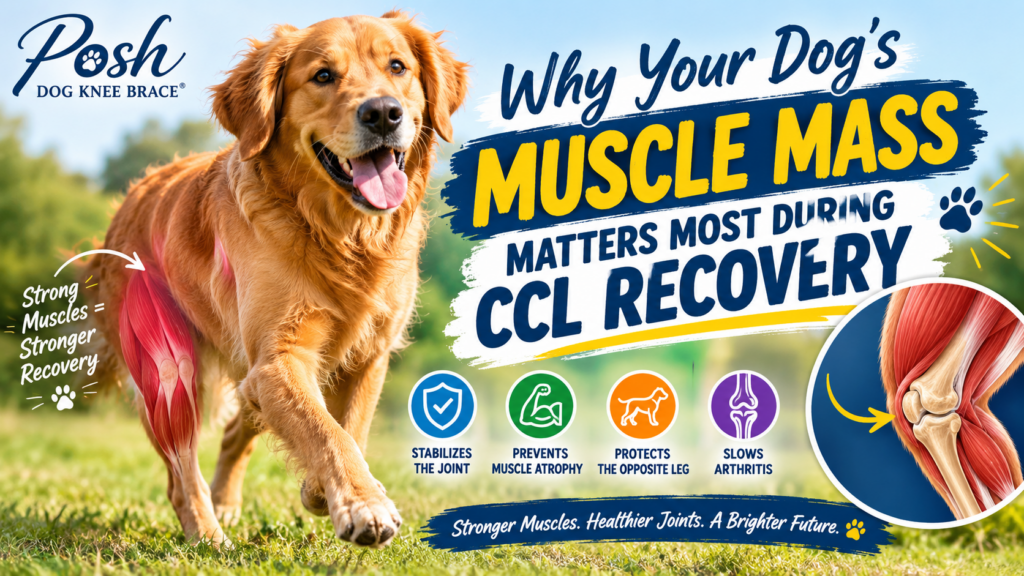
The CCL’s job is to act like a seatbelt, stopping the shinbone from sliding out from underneath the thighbone. When that ligament is damaged, the mechanical stability is lost.
This is where the quadriceps and hamstring muscles come to the rescue. When these powerful leg muscles are thick, strong, and well-conditioned, they act as an active, living brace around the knee. Strong muscles contract to clamp the joint in place, severely reducing the painful grinding (tibial thrust) that happens every time your dog takes a step.
The moment a dog injures their knee, they naturally stop putting full weight on it. Within just two to three weeks of favoring a leg, rapid muscle wasting (atrophy) begins.
This creates a dangerous downward spiral:
Breaking this cycle early by safely engaging the muscles is crucial for your dog’s long-term mobility.
As mentioned in previous articles, up to 60% of dogs will tear the CCL in their opposite leg within a year or two of the first injury.
Why? Because when a dog loses muscle mass and function in the injured hind leg, they aggressively shift their body weight forward and onto the opposite good knee. If you can preserve and rebuild the muscle mass in the injured leg quickly, your dog will return to a balanced, symmetrical gait much faster, saving the remaining healthy knee from catastrophic overload.
Every dog with a CCL injury will experience some degree of arthritis. However, dogs with excellent muscle mass experience significantly slower arthritis progression. Strong muscles absorb the concussive shock of walking and running. If the muscles are weak, that raw, heavy impact forces its way directly into the bone surfaces and cartilage, accelerating joint wear, inflammation, and chronic pain.
You cannot simply take a recovering dog out for a run to build muscle; high-impact twisting and sprinting will ruin their recovery. Muscle building post-CCL injury must be low-impact and controlled:
Utilize a Custom Rigid Brace: If you are navigating recovery without surgery, a custom device like the Posh Dog Knee Brace holds the bones in alignment, giving your dog the immediate confidence to stand squarely on the leg. This weight-bearing allows them to build active muscle mass during daily walks instead of letting the leg waste away.
The Bottom Line: A knee joint is only as strong as the engine driving it. By focusing heavily on preserving and rebuilding your dog’s thigh muscle mass through targeted, safe exercises, you aren’t just healing a ligament — you are bulletproofing their entire lower body against future injury. Come visit us on Facebook too, where we share daily recovery tips and success stories from dogs just like yours: facebook.com/poshdogkneebrace
Articles from the Posh Dog Knee Brace team — a group effort with our licensed veterinary technicians and brace specialists, sharing 15+ years of experience helping dogs recover from CCL/ACL injuries and mobility challenges.
If your dog freezes when wearing their brace for the first time, don’t panic. You’ve spent weeks researching, took precise measurements, and finally received your custom Posh Dog Knee Brace. You carefully put it on your dog, stand back to admire the fit, and… your dog turns into a statue. They completely freeze, refuse to move a muscle, or look at you with total betrayal. If they do take a step, they might lift the leg up like a robot or try to walk backward.
First, take a deep breath: This “statue behavior” is completely normal, incredibly common, and does not mean the brace hurts.
To a dog, a custom rigid brace feels like a brand-new sensory experience. They don’t immediately realize it’s there to support them; they just know something is hugging their leg, and their natural instinct is to freeze until they figure it out. Here is how to break the spell and guide your pup through their first fitting.
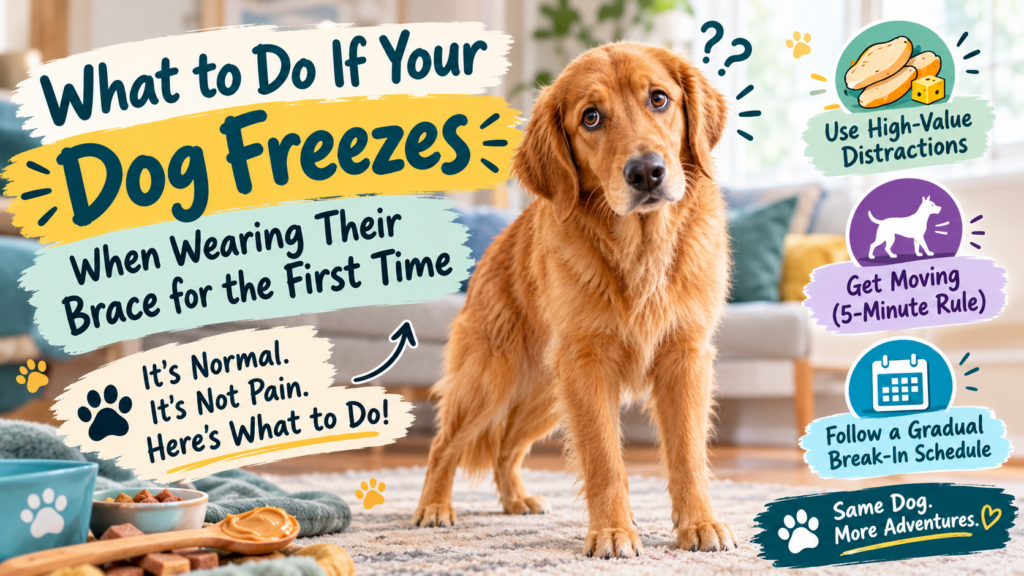
When a dog first feels the secure compression of an orthopedic brace, their nervous system misinterprets the sensation. Because the brace places gentle pressure on the skin and muscles, your dog’s brain thinks something is trapping or holding their leg.
Freezing or lifting the leg up exceptionally high is just their way of testing the boundaries. It is almost never a sign of physical pain. In fact, once they take just a few steps, they will quickly realize that the painful “slipping” sensation inside their knee is gone.
If your dog freezes when wearing their brace, do not try to physically push or pull them forward. This will only increase their anxiety and make them resist the brace. Instead, you need to trick their brain into focusing on something much better than their leg.
The faster you can get your dog to stop thinking about the brace and start moving, the faster their brain will adapt to the new sensory input.
Do not expect your dog to wear their custom brace all day on day one. Bracing requires a patient, incremental adjustment period to allow their skin and muscles to adapt to the rigid structure.
The Bottom Line: Don’t let a rocky first five minutes discourage you — it’s completely normal when your dog freezes when wearing their brace for the first time. Your dog just needs a little time, a lot of encouragement, and some premium treats to realize that their new custom brace is actually their ticket back to a pain-free, active life. Next read: How to Stop Your Dog’s High-Impact Leaps During CCL Recovery
Want to learn more about the Posh Dog Knee Brace? If your dog is dealing with a CCL or ACL injury, we’d love to help — reach out through our contact form at https://poshdogkneebrace.com/contact/ and our team will get back to you. You can also find us on Facebook at https://www.facebook.com/poshdogkneebrace to connect with our community of dog parents.
Articles from the Posh Dog Knee Brace team — a group effort with our licensed veterinary technicians and brace specialists, sharing 15+ years of experience helping dogs recover from CCL/ACL injuries and mobility challenges.
The easiest way to stop dog jumping off the couch is to remove the opportunity entirely. When your dog is recovering from a Cranial Cruciate Ligament (CCL) injury, your home suddenly turns into an obstacle course. You might have the perfect custom brace, a dedicated rehab routine, and a strict short-leash walking schedule. But there is one major household hazard that can ruin months of healing scar tissue in a split second: the high-impact leap off the couch or bed.
When a dog launches themselves off furniture, their front legs take the brunt of the landing, but their hind legs absorb a massive, concussive twist upon takeoff and landing. If your dog is navigating a knee injury, a single leap can instantly re-tear a healing ligament or crush a vulnerable meniscus.
Here is how to stop dog jumping off the couch and protect your dog’s joints during recovery.
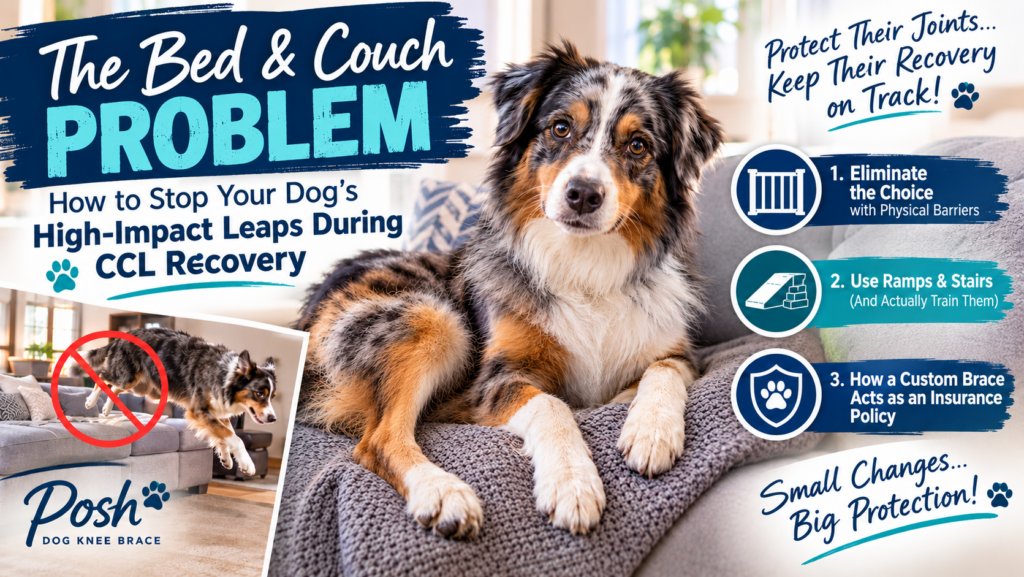
The easiest way to stop a dangerous jump is to remove the opportunity entirely. While your dog is healing, their access to high furniture must be strictly managed.
Buying a pet ramp or a set of foam stairs is only half the battle. If you simply place a ramp next to the couch, a dog’s instinct is to completely ignore it and jump right over it. You have to actively teach them that the ramp is their only pathway.
Despite our best efforts, accidents happen. A doorbell rings, a squirrel runs past the window, and your dog takes a sudden, reactive leap before you can stop them.
This exact scenario is why many pet parents utilize a rigid orthopedic device like the Posh Dog Knee Brace, even when their dog is inside the house. Because a custom brace acts like an external skeletal support, it takes the heavy mechanical shock off the knee joint. If your dog accidentally slips or jumps, the brace strictly prevents the bones from sliding out of alignment, preventing a catastrophic reinjury.
The Bottom Line: Healing a CCL injury requires a lifestyle shift. By combining strict environmental management to stop dog jumping off the couch, patient ramp training, and the structural safety of a custom brace, you can protect your dog from dangerous impact forces and keep their recovery moving smoothly forward.
If you’re struggling to stop dog jumping off the couch during CCL recovery and want the added protection of a custom brace, we’d love to help. Posh Dog Knee Brace has helped 14,000+ dogs recover from CCL/ACL injuries over 15 years — without surgery. Contact us through the contact form at poshdogkneebrace.com or visit us on Facebook, and our team will guide you through measuring, fitting, and getting your dog safely back on their feet.
Articles from the Posh Dog Knee Brace team — a group effort with our licensed veterinary technicians and brace specialists, sharing 15+ years of experience helping dogs recover from CCL/ACL injuries and mobility challenges.
If your dog slips and slides on hardwood, tile, laminate, or other smooth flooring, you may have heard about toe grips for dogs. These small rubber grips are designed to fit over a dog’s toenails and provide additional traction when their paws come into contact with slippery surfaces.
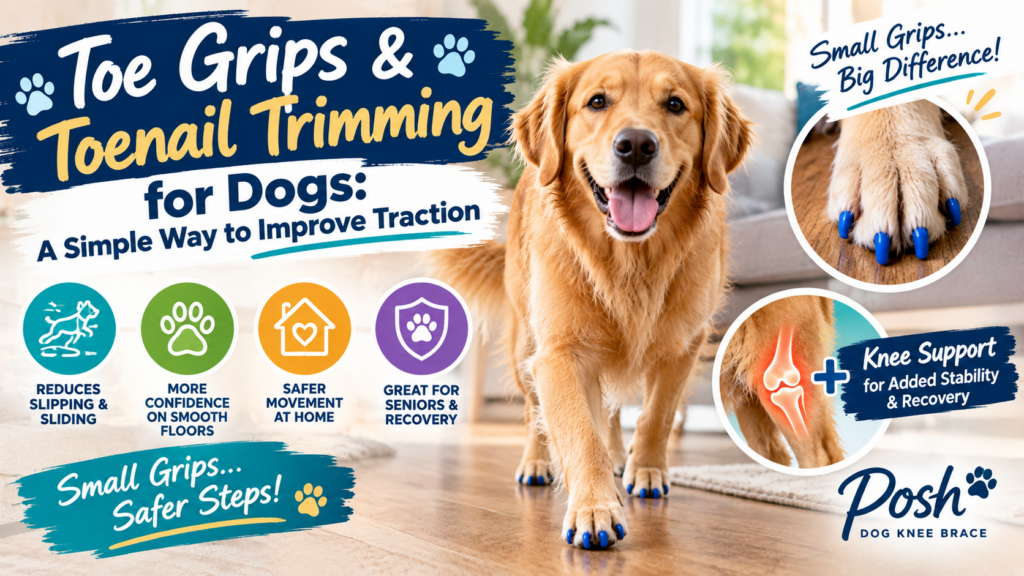
Toe grips are small, flexible rubber or silicone-like pieces that slide over a dog’s toenails. Unlike traditional dog boots, they don’t cover the entire paw. Their purpose is to give the nails more grip against the floor, helping reduce slipping.
Because they are lightweight and relatively unobtrusive, many dogs can wear them without the bulk associated with shoes or booties. They are available in different sizes, so choosing the correct size for your dog’s nails is important.
Dogs naturally rely on their paw pads and nails for traction. On grass, dirt, carpet, and other textured surfaces, this usually isn’t a problem. Smooth indoor flooring, however, can be much more difficult to navigate.
When a dog walks across a slippery floor, their nails may slide instead of helping them maintain traction. Toe grips can provide another point of contact with the flooring.
Better traction may help your dog:
Toe grips can be particularly useful for senior dogs, dogs with reduced strength or mobility, and dogs recovering from orthopedic injuries. Some dogs naturally become less stable as they age, while others may have difficulty controlling their legs because of weakness or changes in mobility.
They may also be helpful for dogs recovering from an ACL/CCL injury. A dog favoring one rear leg may already be putting more weight on the opposite leg. Frequent slipping can make movement even more difficult.
However, toe grips should be considered a traction aid, not a treatment for an underlying orthopedic condition.
For a dog recovering from an ACL/CCL injury, creating a safer environment is an important part of recovery. Adding rugs or runners to slippery areas, limiting uncontrolled activity, following your veterinarian’s rehabilitation recommendations, and improving traction can all help.
For dogs that need additional knee stability, a properly fitted Posh Dog Knee Brace can provide orthopedic support while the dog walks and participates in controlled activities.
Toe grips and a knee brace serve different purposes. Toe grips primarily help with traction, while a knee brace is designed to provide support and stability to the injured knee.
Proper fit is important. Toe grips should be appropriately sized for your dog’s nails and should not be excessively tight or uncomfortable. Follow the manufacturer’s instructions for application and check your dog’s nails and toes regularly.
If your dog repeatedly tries to remove the grips, seems uncomfortable, develops irritation, or has difficulty walking while wearing them, remove them and speak with your veterinarian or a qualified professional.
Occasional slipping on a slick floor may simply be a traction issue. But if your dog suddenly starts slipping, struggles to stand, frequently falls, limps, or avoids putting weight on a leg, there may be an underlying medical or orthopedic problem.
Toe grips can be a useful tool for improving traction, but they aren’t a substitute for veterinary evaluation when a dog is experiencing pain, weakness, or mobility changes.
For dogs dealing with knee instability or an ACL/CCL injury, combining better traction with appropriate veterinary care and orthopedic support can help create a safer environment for recovery and everyday movement.
If you’d like more information about our Posh Dog Knee Brace, visit us on Facebook or contact us via our contact form.
Articles from the Posh Dog Knee Brace team — a group effort with our licensed veterinary technicians and brace specialists, sharing 15+ years of experience helping dogs recover from CCL/ACL injuries and mobility challenges.
When your dog is recovering from an injury, surgery, arthritis, or another mobility issue, physical therapy can play an important role in helping them regain strength, balance, and confidence.
While your veterinarian or canine physical therapist should guide your dog’s specific rehabilitation plan, there are several at-home physical therapy tools for dogs that can make it easier to incorporate safe, gentle exercises into your dog’s daily routine.
From therapy balls to balance equipment, these products can help turn part of your home into a comfortable rehabilitation space.
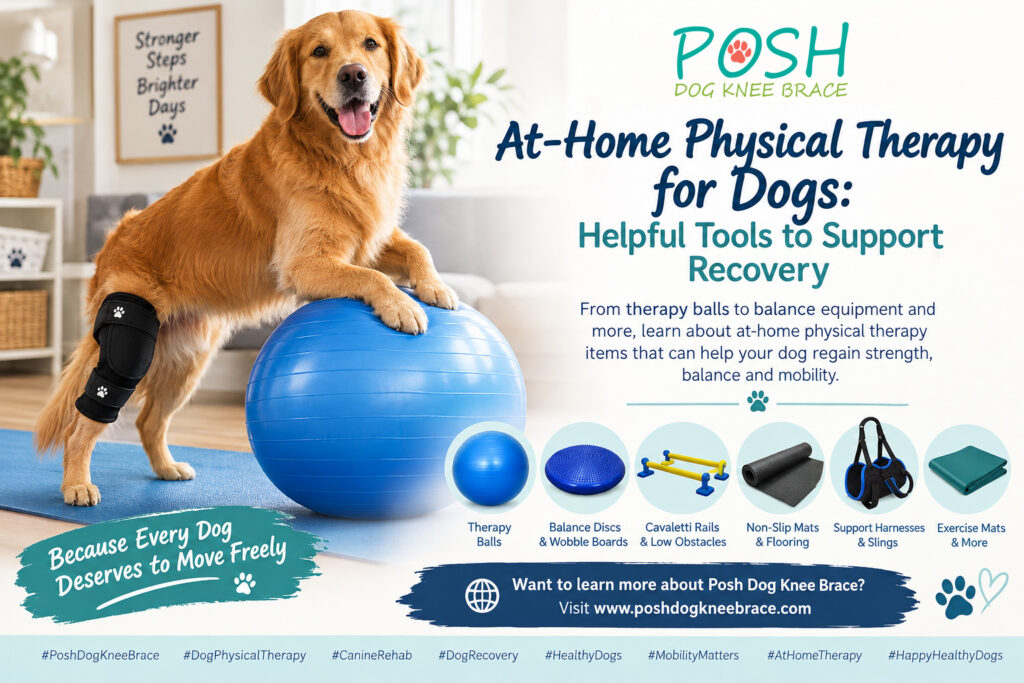
Dogs recovering from knee injuries, ligament problems, arthritis, or other orthopedic conditions may experience muscle weakness and reduced range of motion.
After a period of reduced activity, the muscles supporting the affected leg can become weaker. Gentle, controlled exercises may help support:
The key is to start slowly and follow the exercise recommendations provided by your veterinarian or canine rehabilitation professional.
One of the most popular pieces of home rehabilitation equipment is a dog physical therapy ball, sometimes called a canine exercise ball or balance ball.
These large, sturdy exercise balls can be used for carefully supervised balance and strengthening exercises. Depending on your dog’s condition and rehabilitation plan, exercises may involve standing with the front or rear legs supported on the ball or performing controlled weight-shifting movements.
A therapy ball may help challenge your dog’s:
Because dogs can easily lose their balance, safety is extremely important. Always use an appropriately sized, durable ball on a non-slip surface and stay right beside your dog during exercises.
If your dog has recently had surgery or has a significant injury, ask your veterinarian or rehabilitation therapist when this type of exercise is appropriate.
Balance discs and canine wobble boards are another option for dogs working on stability and body awareness.
These tools create an unstable surface that encourages a dog to engage their muscles to maintain balance. A rehabilitation professional can show you exercises that are appropriate for your dog’s current ability.
Balance equipment can be particularly useful as your dog progresses through rehabilitation, but it isn’t necessarily appropriate during every stage of recovery.
Cavaletti exercises use low rails or obstacles that a dog carefully steps over.
These exercises can encourage controlled movement and help your dog become more aware of where they are placing their feet.
You don’t necessarily need expensive equipment to get started. With guidance from your dog’s rehabilitation professional, appropriately positioned low obstacles can sometimes be incorporated into a home exercise routine.
The goal should be slow, controlled movement — not jumping or rushing.
One of the simplest and most useful things you can add to your home is something many people overlook: secure footing.
Hardwood, tile, and other slippery surfaces can be challenging for dogs with weak legs or mobility problems. Non-slip rugs, rubber-backed mats, or other stable flooring can help give your dog more confidence when walking around the house.
Consider placing non-slip surfaces in areas where your dog frequently gets up, lies down, eats, drinks, or walks.
A properly designed support harness or sling can help provide assistance when your dog needs help standing, walking, or navigating certain areas of the home.
These products can be particularly useful for dogs that are temporarily weak after surgery or an injury.
However, support equipment should be used correctly. Your veterinarian or rehabilitation professional can demonstrate how to support your dog without placing unnecessary stress on an injured limb.
A thick, supportive exercise mat can provide a comfortable and stable surface for rehabilitation exercises.
Look for a mat that provides good traction and doesn’t slide across the floor when your dog moves.
A dedicated exercise area can also help make rehabilitation part of your dog’s daily routine.
Depending on your dog’s condition, your veterinary rehabilitation professional may recommend gentle massage or passive range-of-motion exercises.
Some pet owners use massage tools or their hands to help with relaxation and muscle comfort.
It’s important to learn the proper techniques before working around an injured or recently operated area. Never force a joint through a movement or continue an exercise that causes your dog pain.
While physical therapy products can be helpful, rehabilitation is about much more than having the right equipment.
Your dog’s recovery may also involve:
Every dog is different, and the right rehabilitation program depends on the underlying condition, age, size, activity level, and stage of recovery.
For dogs dealing with knee instability or certain orthopedic conditions, a properly fitted knee brace may be another option to discuss with your veterinarian.
A canine knee brace can provide external support while your dog is moving and participating in appropriate activities. Depending on the individual dog and condition, a brace may be incorporated into a broader mobility and rehabilitation plan.
At Posh Dog Knee Brace, we focus on custom dog knee braces designed to provide support for dogs experiencing knee-related mobility challenges.
A knee brace is not a replacement for veterinary care or a rehabilitation program. Instead, it can be one part of a comprehensive approach to helping your dog stay mobile and supported.
You don’t need to turn your entire house into a physical therapy clinic.
Start by creating a small, safe area where your dog can perform approved exercises without slipping or getting distracted. Keep frequently used items nearby, and make sure the area is free from furniture or objects your dog could bump into.
Most importantly, follow the exercise plan provided by your dog’s veterinarian or canine rehabilitation professional.
More exercise isn’t always better. Recovery is about performing the right exercises at the right time and gradually progressing as your dog becomes stronger.
Recovering from an injury can be a long process, but small, consistent efforts can make a big difference in your dog’s daily mobility and quality of life.
Physical therapy balls, balance equipment, non-slip mats, support harnesses, and other rehabilitation products can be useful tools for an appropriate at-home exercise program.
And if your dog is struggling with knee instability, a custom knee brace may be another option worth discussing with your veterinary care team.
If you’re looking for more information about how a Posh Dog Knee Brace may fit into your dog’s mobility and rehabilitation plan, we’d love to help.
Visit www.PoshDogKneeBrace.com to learn more about Posh Dog Knee Brace and get more information about custom knee brace options for your dog, or check us out on Facebook. Your dog’s journey to better mobility starts with the right support, the right plan, and plenty of patience.
Articles from the Posh Dog Knee Brace team — a group effort with our licensed veterinary technicians and brace specialists, sharing 15+ years of experience helping dogs recover from CCL/ACL injuries and mobility challenges.
Dogs may not be able to tell us how they feel with words, but they communicate constantly through their body language, facial expressions, and behavior. Learning to recognize these signals can help you understand your dog better and strengthen the special bond you share.
So, how do you know when your dog is truly happy?
While every dog has their own personality, there are several common signs of happiness in dogs that can help you recognize when your furry friend is feeling comfortable, content, and loved.
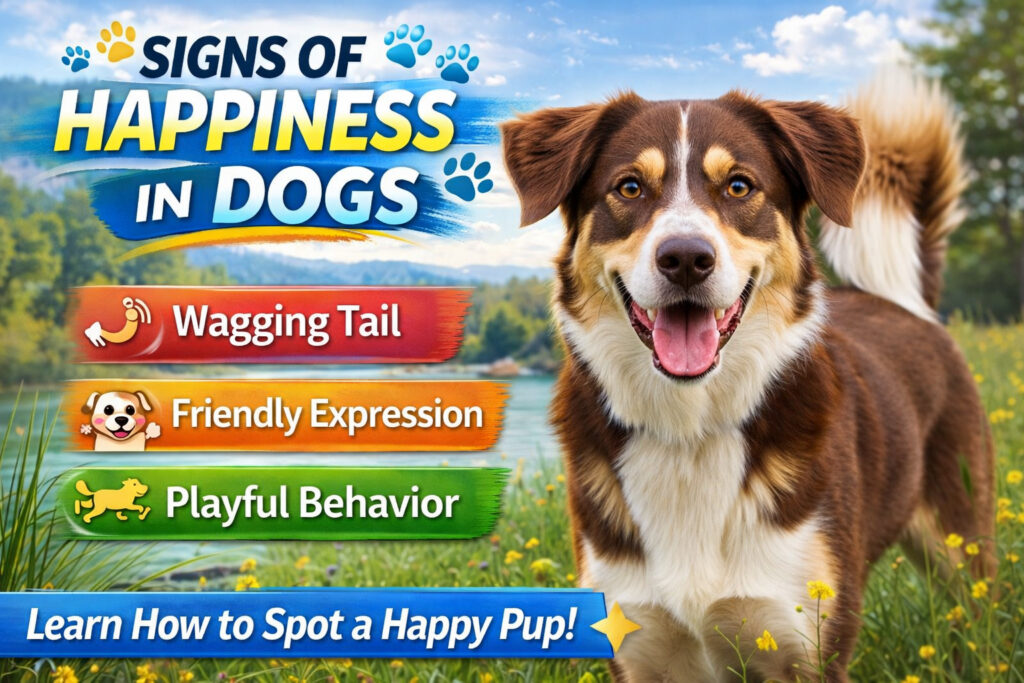
A wagging tail is one of the most recognizable signs of a happy dog—but context matters.
A loose, relaxed tail wag accompanied by a relaxed body often indicates that your dog is comfortable and happy. You may even see their entire back end wiggling with excitement when they greet you!
However, not every tail wag means happiness. A stiff, rapid, or high-held tail can indicate excitement, anxiety, alertness, or overstimulation.
Look at your dog’s whole body, rather than relying on their tail alone.
A happy dog typically looks comfortable in their body.
You may notice your dog standing, sitting, or lying down with relaxed muscles and an easy posture. Their weight may be evenly distributed, and they won’t appear tense or stiff.
A dog who is comfortable enough to stretch out, roll onto their side, or take a deep, relaxing nap is often showing that they feel safe in their environment.
Your dog’s eyes can tell you a lot about how they’re feeling.
Happy and relaxed dogs often have bright, alert eyes with a soft gaze. Their eyelids may appear slightly relaxed rather than wide and tense.
When your dog looks at you with soft, relaxed eyes, especially while their body is loose and their tail is gently wagging, it can be a wonderful sign that they feel comfortable and connected to you.
Playfulness is one of the easiest signs of a happy dog to recognize.
A happy dog may:
The classic play bow, where your dog’s front legs stretch forward while their rear end stays up, is a common invitation to play.
When your dog wants to interact and have fun, they’re often showing that they feel good and secure.
Your dog’s ears can provide another clue about their emotional state.
When a dog is happy and comfortable, their ears are generally relaxed and positioned naturally for their breed. They may be slightly forward when they’re interested in something.
It’s important to remember that ear position varies significantly between breeds. A German Shepherd and a Basset Hound won’t necessarily display happiness with their ears in the same way.
That’s why it’s best to consider ear position alongside the rest of your dog’s body language.
When your dog rolls onto their back and exposes their belly, it can be a sign that they feel comfortable and trust you.
Some dogs love having their belly rubbed, while others simply enjoy lying on their backs because it feels comfortable.
However, don’t automatically assume every belly-up position means, “Rub my belly!” A dog may also roll over as a submissive or appeasing behavior.
Look for other signs of relaxation, such as a loose body, soft eyes, and a relaxed mouth.
Dogs have plenty of ways to “talk” without barking.
Some dogs make adorable little grunts, sighs, groans, or soft vocalizations when they’re comfortable and content. You may hear a big sigh when your dog settles down beside you after a long day.
Of course, vocalizations can mean different things depending on the situation, so consider what else your dog is doing at the same time.
A dog who is excited about mealtime may show their happiness through their appetite.
Running to their food bowl, eagerly waiting for dinner, or happily accepting treats can all be normal signs of enthusiasm.
However, appetite alone isn’t a reliable measure of happiness. Changes in eating habits can sometimes indicate stress, illness, pain, or other health concerns.
If your dog’s appetite suddenly changes, especially when accompanied by other behavioral changes, it’s a good idea to consult your veterinarian.
Does your dog follow you from room to room?
For many dogs, this is simply their way of staying close to the person they love.
A happy, bonded dog may want to be wherever you are—whether you’re cooking dinner, watching television, working around the house, or simply relaxing.
Some dogs are naturally more independent, while others are your constant four-legged shadow. Both can be perfectly normal.
A happy dog’s mouth often looks soft and relaxed.
You may see their mouth slightly open with their tongue resting naturally. Their facial muscles will generally appear loose rather than tight or tense.
A relaxed mouth combined with soft eyes, a loose body, and a gently wagging tail can be a strong indication that your dog is comfortable and content.
A dog’s emotional well-being is closely connected to their physical comfort.
Dogs who are experiencing pain or mobility problems may become less playful, reluctant to exercise, or less interested in activities they normally enjoy. Knee and joint problems, including cranial cruciate ligament (CCL) injuries, can affect how comfortable a dog feels during everyday activities.
That’s why paying attention to changes in your dog’s movement and behavior is so important.
A dog who is comfortable, supported, and able to participate in the activities they enjoy is more likely to stay active and engaged with their family.
Whether it’s a favorite toy, a walk around the neighborhood, a game of fetch, a belly rub, or simply curling up beside you on the couch, happiness for dogs often comes down to feeling safe, loved, comfortable, and connected.
Your dog may not be able to say, “I’m happy,” but they’re probably telling you in a dozen different ways every day.
All you have to do is learn how to listen.
Because a happy dog isn’t just a wagging tail—it’s a relaxed body, bright eyes, playful spirit, and the unmistakable joy of being with the people they love.
If your dog is dealing with a knee injury, mobility challenges, or you simply want to learn more about how a Posh Dog Knee Brace may help support your dog’s active lifestyle, we’re here to help! Our team is happy to answer your questions and help you determine whether a Posh brace may be a good option for your dog. Contact us through our Contact page to speak with our team, or follow along on Facebook for helpful tips, educational information, customer stories, and updates from Posh Dog Knee Brace. We’re here to help you keep your best friend comfortable, supported, and enjoying life on all four paws!
Articles from the Posh Dog Knee Brace team — a group effort with our licensed veterinary technicians and brace specialists, sharing 15+ years of experience helping dogs recover from CCL/ACL injuries and mobility challenges.
When most dog owners think about ACL injuries, they picture a dramatic event—a dog sprinting across the yard, making a sharp turn at the dog park, jumping off the couch, or landing awkwardly after a game of fetch.
But sometimes, the problem isn’t happening at the park.
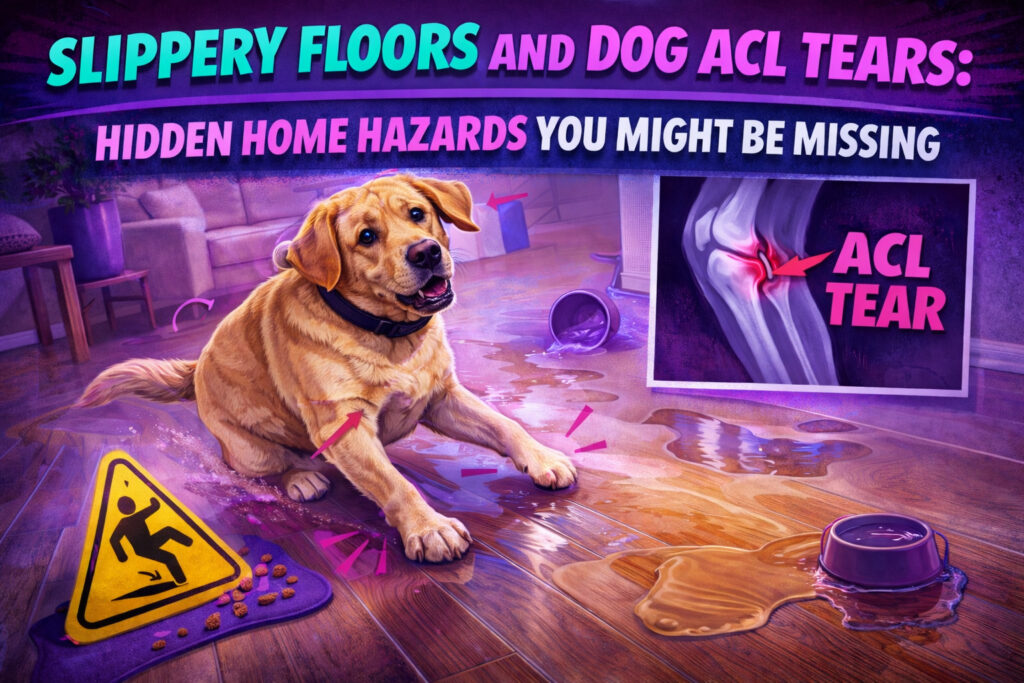
Hardwood, tile, laminate, vinyl, polished concrete, and other smooth flooring surfaces can create a surprisingly difficult environment for dogs to navigate. What feels perfectly normal to us can be challenging for a dog whose paws are constantly trying to find enough traction to keep the body stable.
A single slip doesn’t necessarily mean a dog will tear a CCL. However, repeated slipping, sliding, sudden twisting, and compensatory movements can place additional stress on the muscles, tendons, and ligaments supporting the knee.
For dogs that are already predisposed to CCL problems—or dogs recovering from a previous injury—traction becomes even more important.
The good news?
You don’t necessarily need to replace your floors.
A few simple changes throughout your home can make your dog’s environment safer and more comfortable.
Dogs depend heavily on traction to control their movements.
When a dog walks or runs across a surface with good grip, the paws can push against the ground while the muscles and joints work together to control the body’s movement.
On a slippery surface, that relationship changes.
Instead of the paw staying firmly planted, it may slide forward, backward, or sideways. When that happens, the dog’s body has to react quickly to prevent a fall.
The result can be:
These movements don’t automatically cause a CCL tear, but they can create situations where the knee experiences forces it wasn’t expecting.
And the problem isn’t necessarily one dramatic slip.
It can be the repetition.
A dog that slides several times every day while getting off the couch, running through the hallway, turning around in the kitchen, or racing toward the front door may repeatedly place stress on its joints.
Over time, those small challenges can become part of the bigger picture of joint health.
The structure commonly called the dog’s ACL is more accurately known as the cranial cruciate ligament (CCL).
The CCL is one of the major stabilizing ligaments inside the dog’s knee, or stifle joint. It helps control forward and rotational movement between the bones of the knee.
When the CCL becomes damaged or ruptures, the knee can become unstable.
A CCL injury can lead to:
Some dogs experience a sudden traumatic rupture, while others develop CCL disease gradually as the ligament weakens over time.
That means prevention isn’t always about avoiding one specific accident.
It’s also about reducing unnecessary stress on the knee whenever possible.
Humans generally have shoes or bare feet with relatively broad contact against the floor.
Dogs are different.
Their paws are smaller points of contact, and their ability to grip a surface depends on the texture of their paw pads, nail length, body position, speed, and the flooring itself.
A healthy dog may compensate easily for an occasional slip.
But consider a dog that is:
That dog may have considerably less room for error.
A slippery floor can turn an ordinary activity—such as standing up and walking across the room—into a balance and stability challenge.
You may already have rugs in your living room and still have several slippery areas that your dog uses every day.
The biggest problems are often found in transition areas and high-excitement zones.
Think about what happens when someone comes home.
Your dog hears the door.
Excitement kicks in.
The dog runs toward the entrance, turns sharply, and may attempt to stop suddenly on a smooth surface.
That combination of speed + excitement + low traction can create an unstable situation.
Consider placing a non-slip runner or mat between the door and the area where your dog typically waits.
Hallways are often overlooked.
They’re long, narrow spaces where dogs naturally pick up speed.
A dog running down a hardwood hallway may suddenly need to turn into another room. If the paws can’t grip the floor, the rear legs can slide while the dog’s body continues moving forward.
A properly secured runner can provide traction along the entire path.
Make sure the rug itself doesn’t slide. A loose rug can create a different hazard.
The kitchen can be a particularly active area for dogs.
Food smells, feeding routines, family activity, and excitement can all encourage a dog to move quickly.
Smooth kitchen flooring can become even more slippery when there is:
A washable, non-slip mat near food and water bowls can help provide a more stable standing surface.
This area deserves special attention.
Dogs frequently shift their weight while eating and drinking. If the bowl slides across the floor or the dog’s paws move while they’re standing, the dog may repeatedly adjust its stance.
Consider using:
The goal is simple:
Keep your dog’s paws underneath them instead of allowing them to slide around.
Stairs already require coordination, balance, and controlled movement.
The landing at the top or bottom can be particularly problematic if the flooring changes from carpet to hardwood, tile, or another slick material.
A dog coming down stairs may have forward momentum and need to stop quickly. Good traction on these transition points can provide an important extra layer of stability.
Jumping isn’t the only concern.
Think about what happens when your dog jumps off furniture.
They land, their weight shifts forward, and they immediately need to stabilize themselves.
If the landing surface is slippery, the paws can slide when the dog hits the floor. For dogs already experiencing knee problems, consider limiting furniture jumping and providing a stable landing area with a non-slip rug or mat.
Exterior doors are another common excitement zone.
A delivery driver arrives.
Someone rings the doorbell.
A family member comes home.
Your dog suddenly goes from lying quietly to sprinting across the house.
That explosive acceleration can be harder on the knees when the floor provides little traction.
A runner or mat along the path your dog usually takes toward the door can help reduce sliding.
Every dog owner knows the zoomies.
One moment your dog is relaxing.
The next moment they’re racing around the house at full speed.
Zoomies aren’t inherently bad. Dogs need opportunities to exercise and play.
The concern comes when high-speed movement meets poor traction.
A dog running on a slippery surface may have difficulty stopping or changing direction.
Instead of slowing down gradually, the dog may:
That sequence can create significant forces through the limbs.
This is one reason providing better traction in the areas where your dog gets the zoomies can be especially valuable.
If your dog has already experienced a CCL injury, flooring deserves even more consideration.
After an injury, dogs often change the way they move.
They may shift more weight onto the opposite leg, shorten their stride, avoid certain movements, or develop compensatory movement patterns.
If the injured leg is painful or unstable, the dog may rely more heavily on the other limb.
That creates an important concern:
The opposite knee may already be working harder than normal.
Adding slippery flooring to the equation can make maintaining balance and controlling movement even more difficult.
This is why traction should be considered part of the overall home environment during recovery—not just something to think about after a slip occurs.
Always follow your veterinarian’s rehabilitation and activity recommendations following an injury or surgery.
The good news is that improving traction usually doesn’t require an expensive home renovation.
Small changes can make a meaningful difference.
Place runners along the routes your dog uses most often.
Good locations may include:
Choose rugs with a secure non-slip backing or use an appropriate rug pad.
A rug that moves underneath your dog isn’t providing the protection you’re looking for.
A sturdy non-slip mat near the front and back doors can help create a traction zone where your dog is most likely to accelerate or stop.
This can be especially useful if your dog becomes excited whenever someone enters or leaves the house.
Water spills can turn an already smooth floor into an extremely slippery one.
Use a mat beneath the bowl and clean up spills promptly.
Long nails can affect how a dog positions its paws and interacts with the floor.
Regular nail maintenance can help your dog maintain better contact with the surface.
If you’re uncomfortable trimming your dog’s nails yourself, ask your veterinarian, groomer, or veterinary professional for assistance.
For dogs with furry feet, excessive hair between the paw pads can sometimes interfere with traction.
Keeping the hair around the paw pads appropriately maintained may help improve contact with the floor. Ask your groomer or veterinary professional about the best approach for your dog’s coat type.
Sometimes the floor isn’t naturally slippery—the cleaning products are the problem.
Certain cleaners can leave behind a residue that makes hard flooring even slicker.
Follow the manufacturer’s cleaning instructions for your flooring and make sure the surface is fully dry before allowing your dog to race across it.
There are paw waxes, grip products, socks, boots, and other products marketed to help dogs navigate slippery surfaces.
Some dogs tolerate these products well, while others don’t.
If you use a traction product, make sure it fits properly and doesn’t interfere with your dog’s natural movement.
Never assume a product is appropriate simply because it is marketed for dogs with mobility problems. If your dog has a known orthopedic condition, ask your veterinarian or rehabilitation professional whether a particular product makes sense for your situation.
Floor traction is only one piece of the puzzle.
A dog’s overall orthopedic health also depends on factors such as:
Maintaining a healthy body condition can reduce the amount of load placed on the joints.
Likewise, appropriate exercise can help maintain muscle strength and coordination.
However, exercise should be appropriate for your dog’s age, health, and orthopedic condition.
If your dog has a known CCL injury, don’t suddenly increase exercise because they seem to be feeling better. A controlled rehabilitation plan is often much safer than allowing a dog to immediately return to unrestricted running and jumping.
Your dog may not obviously limp after slipping.
Instead, watch for subtle behaviors such as:
If you notice a change in your dog’s movement, don’t automatically assume it’s simply because the floor is slippery. A change in gait, reluctance to move, or recurring lameness can be a sign of an underlying orthopedic problem and should be discussed with your veterinarian.
It’s important to be realistic.
No flooring change can guarantee that your dog won’t develop a CCL injury.
CCL disease is complex, and many factors can contribute to ligament injury.
However, reducing unnecessary slipping can be a sensible part of creating a safer environment for your dog’s joints.
Think of it the same way you might think about other forms of injury prevention.
You can’t eliminate every risk.
But you can reduce avoidable ones.
If your dog repeatedly loses traction while running through the hallway, why not add a runner?
If the water bowl constantly slides across the kitchen floor, why not put it on a non-slip mat?
If your dog struggles to get traction when getting off the couch, why not create a stable landing area? These are small changes that can make your dog’s daily environment more supportive.
If your dog has already been diagnosed with a CCL injury, preventing additional slips becomes even more important.
Your veterinarian may recommend restrictions on running, jumping, stairs, and other high-impact activities depending on your dog’s specific condition and treatment plan.
For some dogs, additional knee support may also be part of their management or rehabilitation strategy.
A properly fitted knee brace can provide external support and stabilization for certain dogs, but a brace should not be considered a replacement for veterinary evaluation or an individualized treatment plan.
At Posh Dog Knee Brace, custom knee braces are designed specifically for individual dogs and can be used as part of a veterinarian-guided approach to managing knee instability.
Because every dog and every CCL injury is different, it’s important to determine whether bracing is appropriate for your dog before choosing a product.
Your home is supposed to be your dog’s safe place.
But smooth flooring can create hidden challenges that are easy to overlook because we don’t experience the floor the way our dogs do.
We walk across hardwood without thinking about it.
Our dogs have to rely on four paws, small contact points, and their own muscles and joints to maintain stability.
That difference matters.
Take a walk through your home from your dog’s perspective.
Look at the areas where your dog:
Now ask yourself:
“Does my dog actually have enough traction here?” You may discover several areas that could be improved with nothing more than a few strategically placed rugs or mats.
A CCL injury can dramatically change a dog’s life.
It can mean weeks or months of restricted activity, rehabilitation appointments, veterinary expenses, muscle loss, and frustration for both the dog and their family.
Not every CCL injury can be prevented.
But responsible dog owners can take reasonable steps to reduce unnecessary stress on their dog’s knees.
Improving traction is one of those steps.
A non-slip runner in the hallway.
A secure mat near the door.
A stable feeding area.
Regular nail care.
A cleaner, less slippery floor.
Controlled activity.
None of these changes seems particularly dramatic on its own.
Together, however, they can create a safer environment for your dog’s joints.
Because protecting your dog’s knees isn’t only about what happens outside the house.
Sometimes, prevention starts right where they take their first step every morning.
If your dog has already experienced a CCL injury or is showing signs of knee instability, talk with your veterinarian about appropriate treatment, rehabilitation, activity modification, and whether a custom knee brace may be appropriate.
A healthier home environment combined with appropriate veterinary care can give your dog the best possible opportunity to stay active, comfortable, and moving forward.
If your dog is dealing with a CCL injury, knee instability, or needs additional support during recovery, we’re here to help.
If you’re interested in learning more about a Posh Dog Knee Brace, have questions about the bracing process, or simply want to find out if a custom knee brace may be an option for your dog, we’d love to hear from you.
Contact us through our website’s Contact page, and our team can help answer your questions and guide you through the next steps.
You can also visit Posh Dog Knee Brace on Facebook to connect with us, see helpful information, follow our latest updates, and hear from other dog owners in the Posh community on Facebook.
Your dog’s journey back to comfortable movement starts with the right support. We’re here to help every step of the way.
Articles from the Posh Dog Knee Brace team — a group effort with our licensed veterinary technicians and brace specialists, sharing 15+ years of experience helping dogs recover from CCL/ACL injuries and mobility challenges.
When a dog is recovering from an ACL (CCL) injury, most pet parents focus on the physical side of healing — restricted activity, leash walks, follow-up vet visits, and joint support. But there’s another side of recovery that’s just as important: your dog’s mental and emotional well-being.
A normally active dog who suddenly can’t run, jump, or play can become frustrated, anxious, or even depressed. Managing that frustration properly can make the difference between a smooth recovery and a painful setback.

Dogs thrive on movement and routine. When those are suddenly taken away, they may:
The challenge? One burst of excitement can re-injure the healing ligament and set recovery back weeks.
1. Create a Calm Recovery Space
Set up a comfortable, confined area with soft bedding, water, and safe chew items. Keeping your dog in a predictable environment helps reduce overstimulation and impulsive movements.
2. Stick to a Structured Routine
Feed, potty, and walk at consistent times each day. Dogs feel more secure when they know what to expect.
3. Offer Mental Enrichment (Without Physical Strain)
Mental stimulation can tire a dog out just as much as physical exercise. Try:
Even 10–15 minutes of brain work can significantly reduce restlessness.
4. Manage Triggers
If your dog gets excited by windows, doorbells, or other pets, limit access during early recovery. Close blinds, use white noise, or separate high-energy household members when needed.
5. Use Controlled Support When your dog is allowed limited movement, proper joint stabilization helps protect healing tissue from sudden twists or slips. Consistent support during approved activity can give you peace of mind while reducing risk. Posh Dog Knee Braces can allow for your dog to get back to doing what they love: walking and going outside! Call posh today, we are here for you.
If your dog shows prolonged appetite loss, extreme lethargy, or heightened anxiety, talk to your veterinarian. Sometimes temporary calming aids or adjustments to the recovery plan can help.
Watching your dog feel restricted is hard. Guilt, worry, and frustration are normal for pet parents. Remember: short-term restriction leads to long-term mobility. Every calm day of recovery is progress toward a stronger, happier future.
ACL recovery isn’t just about healing a ligament — it’s about supporting your dog’s whole well-being. When you manage their mental state as carefully as their physical activity, you dramatically reduce the risk of setbacks and help them return to the life they love. Please call us at Poshdogkneebrace.com, our techs are skilled and trained to give you hope and healing.
If you are interested in a Posh Dog Knee Brace to help your pup through their recovery journey, we would love to help! Feel free to reach out to us via the contact form on our website at Posh Dog Knee Brace
or connect with us on Facebook. Our skilled and trained techs are here to give you hope and healing every step of the way!
Articles from the Posh Dog Knee Brace team — a group effort with our licensed veterinary technicians and brace specialists, sharing 15+ years of experience helping dogs recover from CCL/ACL injuries and mobility challenges.
For many dog owners, watching their furry friends romp and play is pure joy. The wagging tails, playful bows, and exuberant chases seem to speak volumes about happiness and healthy socialization. But beneath the surface of what looks like “fun,” subtle (and sometimes not-so-subtle) stress signals can often go unnoticed.
Just like humans, dogs communicate constantly through their body language. Understanding these unspoken cues is not just a fascinating skill; it’s a crucial responsibility for every dog owner. It allows us to advocate for our dogs, intervene before play escalates into conflict, and prevent potential accidents or injuries. This is especially vital in environments like dog parks, playdates, or even multi-dog households where interactions can quickly become overwhelming.
This guide will dive deep into canine body language, helping you decode common stress signals your dog might be displaying during playtime, ensuring safer and happier interactions for everyone involved.
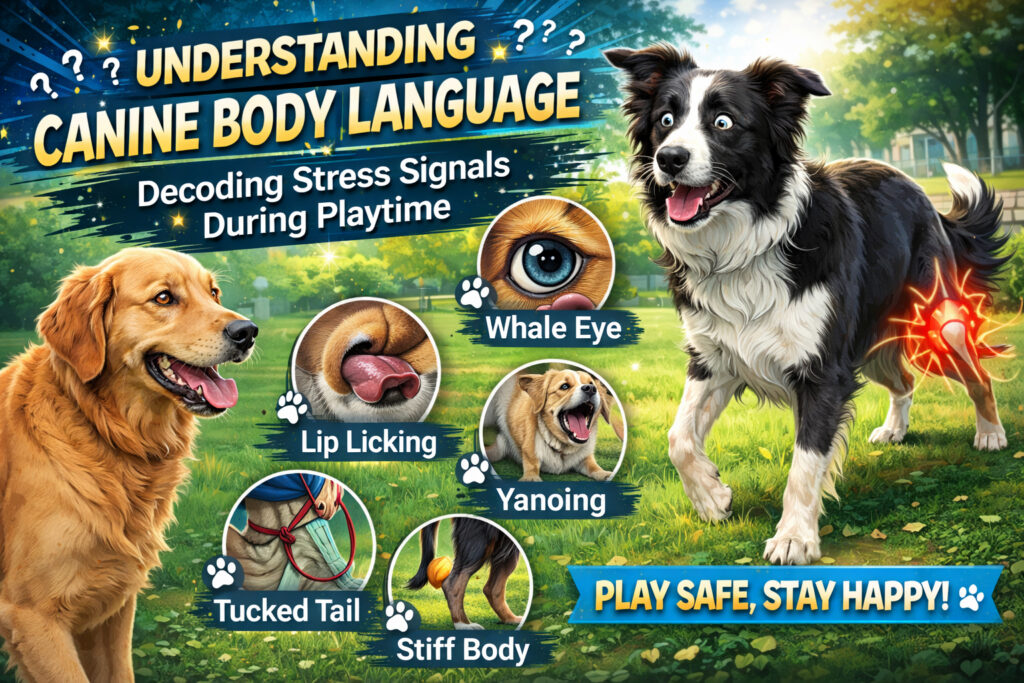
Misinterpreting canine body language can lead to:
Your dog is always telling you how they feel; you just need to learn how to listen with your eyes.
Dogs use their entire body to communicate: their eyes, ears, mouth, tail, posture, and even the direction of their gaze. It’s a complex tapestry of signals, often read in combination.
Before diving into stress, let’s briefly touch on what relaxed, happy play typically looks like:
Now, let’s look at the signals that indicate your dog might be uncomfortable, stressed, or nearing their limit. These are often called “calming signals” or “stress signals” and are attempts to de-escalate a situation or communicate discomfort.
1. Whale Eye (Half Moon Eye) 😳
2. Lip Licking & Yawning 👅
3. Freezing / Stiff Body Posture 🥶
4. Tucked Tail 🤫
5. Head Aversion / Turning Away ↩️
6. Piloerection (Raised Hackles) ⚡
7. Excessive Panting (When Not Overheated) 🥵
Learning these signals is only half the battle. The other half is knowing when and how to intervene.
By becoming fluent in canine body language, you empower yourself to be your dog’s best advocate, transforming potentially risky playtime into genuinely positive and safe social interactions. This skill not only prevents injuries but also builds a deeper bond of trust and understanding between you and your cherished companion.
If you are inteterested in a Posh Dog Knee Brace you can contact us via our contact form or check us out on Facebook.
Articles from the Posh Dog Knee Brace team — a group effort with our licensed veterinary technicians and brace specialists, sharing 15+ years of experience helping dogs recover from CCL/ACL injuries and mobility challenges.
If your dog has suffered a torn ACL (more accurately called a CCL — cranial cruciate ligament), you already know how heartbreaking it is to watch them limp, struggle to stand, or hesitate before jumping onto the couch. But what many pet parents don’t realize is this:
The first ACL tear dramatically increases the risk of a second tear in the opposite leg.
In fact, studies estimate that 40–60% of dogs who tear one CCL will tear the other within 1–2 years. Why does this happen? The answer lies in how dogs instinctively protect an injured leg — and how that compensation creates dangerous strain elsewhere.
Let’s break down what’s happening inside your dog’s body and what you can do to reduce the risk of an injured leg.

In dogs, the ACL is technically called the cranial cruciate ligament (CCL). It sits inside the stifle joint (the canine version of the knee) and helps:
When this ligament partially or fully tears, the joint becomes unstable. That instability causes inflammation, pain, and progressive arthritis if not managed properly.
Dogs are masters of adaptation. Unlike humans, they don’t understand “rest this leg for 6 weeks.” Instead, they shift their weight automatically to avoid discomfort.
This protective response is called compensatory weight shifting.
When one hind leg hurts, your dog will:
At first glance, this seems smart — and it is. In the short term, compensation reduces pain.
But in the long term, it creates a biomechanical imbalance.
Here’s where the risk begins.
1. Increased Load on the Opposite Leg (Injured Leg)
When your dog shifts weight away from the injured leg, the opposite hind leg absorbs significantly more force than it was designed to handle.
Think of it like driving a car with one worn tire — the other tire now bears more stress.
Over time:
If the second ligament was already slightly weakened (which is common), the added strain may push it past its breaking point.
2. Underlying Degeneration Is Often Bilateral
Many CCL tears are not caused by sudden trauma. They’re caused by degenerative ligament disease, which often affects both knees.
That means when one ligament tears, the other is usually already compromised — just not yet ruptured.
Compensation simply speeds up what was already developing.
3. Muscle Imbalance Worsens Instability
When a dog protects one injured leg:
Strong muscles help stabilize the knee. When muscle balance disappears, joint stability decreases — increasing strain on both ligaments.
4. Altered Gait Mechanics Increase Shear Forces
The CCL’s main job is preventing the tibia from sliding forward during weight bearing.
When a dog shifts weight unevenly:
It only takes one awkward movement — jumping off the couch, slipping on tile, or turning sharply — for the second ligament to tear.
While every dog is different, research suggests:
Breeds commonly affected include:
But any dog can develop bilateral CCL disease.
Because dogs are good at hiding pain, the second tear often seems “sudden.” In reality, warning signs may have been present.
Watch for:
If your dog had one ACL tear and you notice these signs, don’t ignore them. Early support can make a difference.
After the first ACL tear — whether surgically repaired or managed conservatively — many owners focus solely on healing that leg.
But if nothing is done to:
…the second ligament remains vulnerable. Protection must be proactive, not reactive.
1. Weight Management Is Critical
Even a few extra pounds dramatically increase joint pressure.
Studies show that overweight dogs are far more likely to experience bilateral CCL tears. Maintaining lean body condition reduces mechanical strain on both knees.
2. Improve Traction at Home
Slipping is a major risk factor.
Consider:
Every slip places shear force on the ligament.
3. Controlled Activity — Not Total Inactivity
Too much activity is risky.
Too little activity leads to muscle loss.
Instead:
Balanced muscle support protects the joint.
4. Provide Strategic Joint Support
Supporting the injured leg is important — but so is protecting the opposite leg.
External stabilization can:
Providing structured support during recovery may reduce stress placed on the “good” leg.
Whether a dog undergoes TPLO, TTA, lateral suture surgery, or conservative care, the second knee remains at risk.
Surgery stabilizes the repaired knee — but it does not eliminate:
This is why many veterinarians counsel owners about the high likelihood of the opposite knee eventually tearing.
The key takeaway?
Rehabilitation and joint protection matter regardless of treatment path.
For many families, the second tear feels worse than the first.
You’ve already:
Hearing that the other knee is now torn can feel overwhelming. But understanding why it happens removes some of the mystery — and empowers you to take preventative action early.
It’s helpful to reframe ACL tears not as a one-time injury, but as part of a broader degenerative condition affecting both knees.
That means:
Prevention isn’t about stopping your dog from living.
It’s about helping them move safely and confidently.
If your dog has already torn one ACL:
If your dog hasn’t torn a ligament but is in a high-risk breed or showing early stiffness, proactive support is even more powerful.
Dogs protect an injured leg because they’re smart and adaptive. But that same protective instinct can overload the opposite knee and accelerate a second ACL tear.
Understanding the biomechanics behind compensation gives you an advantage.
The goal isn’t to eliminate risk completely — that’s rarely possible.
The goal is to:
With the right awareness and proactive care, you can significantly lower the chances that one ACL tear turns into two.
And that means fewer surgeries, less pain, and more confident movement for your dog — for years to come.
If you’re interested in learning more about a Posh Dog Knee Brace and how it may help support your dog’s knee during recovery, or injured leg please visit our contact form to get in touch with us. You can also follow us and connect with us on Facebook for helpful tips, updates, and information about canine knee health. We’re here to help you and your dog every step of the way!
Articles from the Posh Dog Knee Brace team — a group effort with our licensed veterinary technicians and brace specialists, sharing 15+ years of experience helping dogs recover from CCL/ACL injuries and mobility challenges.
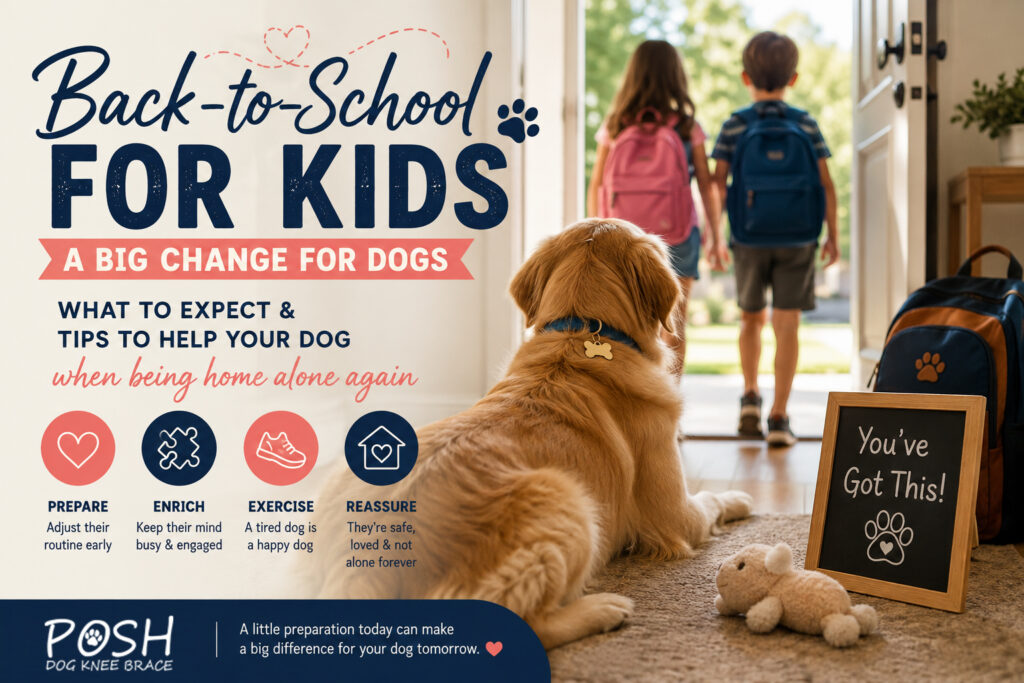
As summer comes to an end, families begin preparing for a new school year. While parents are busy buying school supplies and getting back into a routine, there’s one family member who often gets overlooked—your dog.
For many dogs, summer is the happiest time of the year. The kids are home, there’s constant activity, more walks, backyard playtime, and plenty of attention. Then suddenly, the house becomes quiet. The kids head back to school, parents return to work, and your dog may find themselves spending several hours alone for the first time in months.
This sudden change in routine can be confusing and stressful for many dogs. Fortunately, with a little preparation, you can help your furry family member transition smoothly into the school-year schedule.
Dogs thrive on routine. During summer break, they become accustomed to:
When those daily interactions suddenly disappear, some dogs may experience:
Not every dog will struggle, but even confident dogs notice when their favorite people are suddenly gone for several hours each day.
Rather than waiting until the first day of school, begin easing your dog into the new routine about one to two weeks beforehand.
Practice leaving the house for gradually longer periods. This helps your dog understand that being alone is temporary and that you’ll always return.
You can also begin waking up earlier, feeding meals at school-year times, and taking walks according to the upcoming schedule.
Small changes made ahead of time often prevent major stress later.
Many owners accidentally increase anxiety by making a big event out of leaving.
Instead of emotional goodbyes:
The goal is to make departures feel completely normal.
Mental stimulation can prevent boredom while your dog is home alone.
Great enrichment ideas include:
Keeping your dog’s brain active can help reduce stress and destructive behavior.
A tired dog is generally a calmer dog.
Before school or work:
Even 20 to 30 minutes of activity can help your dog relax during the day.
Some dogs feel more comfortable with familiar sounds.
Consider leaving:
This can help mask outdoor noises and make the home feel less empty.
Some dogs develop true separation anxiety rather than simply missing their family.
Signs may include:
If these behaviors become severe, consult your veterinarian or a certified dog behavior professional as early intervention often leads to better outcomes.
If your dog is healing from a torn ACL (CCL), TPLO surgery, arthritis, or another orthopedic condition, the return to school can present additional challenges.
Without family members around to monitor activity, some dogs may become overly excited when everyone returns home, increasing the risk of re-injury.
Maintain any rehabilitation plan recommended by your veterinarian, continue prescribed exercise restrictions, and consider supportive mobility devices if appropriate. Dogs using a custom knee brace should continue wearing it according to their veterinarian’s or rehabilitation specialist’s recommendations to help support healing and stability during activity.
When the kids return from school, spend a few minutes reconnecting with your dog.
Try:
This helps reinforce that good things happen when everyone comes home.
Just like children need time to settle into a new school routine, dogs need time to adapt to changes in their daily lives.
With patience, consistency, and a little planning, most dogs adjust within a few weeks and become comfortable with the quieter daytime schedule again.
Your dog’s happiness depends on more than just exercise—it depends on routine, enrichment, and knowing their family always comes back home.
As you prepare backpacks, lunches, and school schedules, don’t forget to prepare your four-legged family member, too. A little extra attention now can make the back-to-school season easier for everyone—especially your loyal best friend.
As your family settles into a new back-to-school routine, don’t forget to make sure your dog has the support they need, too—especially if they’re recovering from a CCL injury, arthritis, or another mobility issue. A custom Posh Dog Knee Brace can help provide stability and confidence so your dog can continue enjoying daily walks, playtime, and life with your family. If you’d like to learn more about whether a custom brace is right for your dog, visit our Contact Us page or connect with us on Facebook. Our team is always happy to answer your questions and help you find the best solution for your four-legged family member.
Articles from the Posh Dog Knee Brace team — a group effort with our licensed veterinary technicians and brace specialists, sharing 15+ years of experience helping dogs recover from CCL/ACL injuries and mobility challenges.
If your dog explodes through the front door like they’ve just been released from a starting gate, you’re not alone.
Doorway launches — that full-speed burst from a standstill — are one of the most overlooked risk factors for knee injuries in dogs.
It looks harmless.
It feels normal.
But biomechanically? It’s one of the highest-stress movements your dog performs.
Let’s break down why.
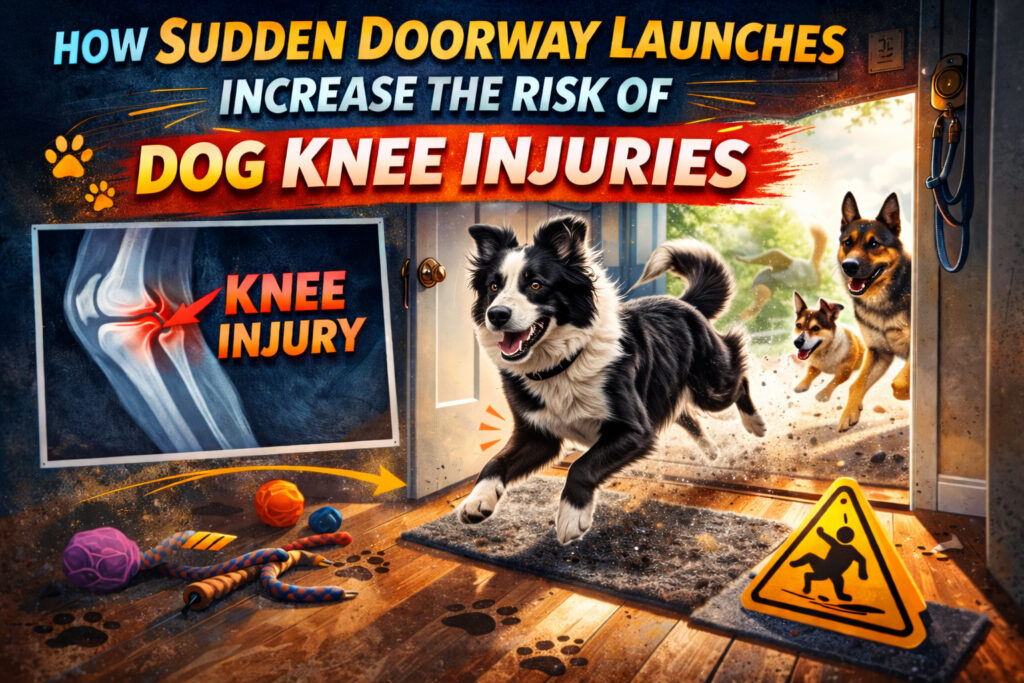
When your dog bolts through a doorway, several things happen at once:
This creates torsion + forward thrust + impact load — the exact combination that stresses the cranial cruciate ligament (CCL), commonly called the ACL in dogs.
The cranial cruciate ligament (CCL) stabilizes your dog’s knee joint and prevents the tibia from sliding forward.
Unlike humans, dogs rarely tear this ligament from a single dramatic event. Most tears are degenerative, meaning the ligament weakens over time.
A sudden doorway launch can be the moment that weakened ligament finally ruptures.
1. Hard, Slippery Surfaces
Entryways are often tile, hardwood, or sealed concrete — all low-traction surfaces.
If the rear foot slips even slightly during push-off, torque increases dramatically at the knee.
2. Sharp Direction Changes
Many dogs don’t run straight out the door. They:
That quick pivot multiplies strain on the CCL.
3. Explosive Push-Off
From a biomechanical standpoint, launching from a stationary stance generates more force than steady acceleration.
It’s similar to a human basketball player jumping into a sprint from a dead stop.
While any dog can experience a knee injury, higher-risk groups include:
Structure, genetics, and body weight all play a role.
Before a full tear occurs, you may notice:
These signs often appear weeks or months before a full rupture.
Here’s what many dog owners don’t realize:
After one CCL tear, the opposite knee has a significant chance of tearing within 1–2 years.
Why?
Because your dog shifts weight to compensate, increasing stress on the “good” leg — especially during high-impact movements like doorway launches.
You don’t have to eliminate excitement — just manage it strategically.
🐾 1. Train a “Wait” Command at the Door
Teaching impulse control reduces explosive launches and protects joints.
🐾 2. Improve Traction
Add:
Better grip = less torque on the knee.
🐾 3. Maintain Ideal Weight
Extra pounds dramatically increase joint stress during acceleration.
🐾 4. Build Controlled Muscle Strength
Strong quadriceps and hamstrings help stabilize the knee and absorb force.
🐾 5. Consider Preventative Support
If your dog shows early instability or has already injured one knee, proactive support can help protect the joint during high-risk movements.
Seek veterinary evaluation if your dog:
Early diagnosis can reduce long-term arthritis progression and joint damage.
Sudden doorway launches may seem harmless, but they combine:
For a healthy ligament, that may not be a problem.
For a weakened one, it can be the tipping point.
The goal isn’t to eliminate your dog’s excitement. It’s to channel it safely.
A few small adjustments at the doorway can protect your dog’s knees — and help keep those joyful sprints injury-free for years to come. 🐾
For more information about our Posh Dog Knee Brace you can contact us via our contact form or visit us on Facebook.
Articles from the Posh Dog Knee Brace team — a group effort with our licensed veterinary technicians and brace specialists, sharing 15+ years of experience helping dogs recover from CCL/ACL injuries and mobility challenges.
Summer is one of the best seasons to spend quality time outdoors with your dog. Longer days, sunny weather, and more opportunities for adventure make it tempting to head outside whenever you have free time. However, when temperatures rise, choosing the right time of day for a walk becomes more than just a matter of convenience—it becomes a matter of your dog’s health and safety.
Whether your dog is a playful puppy, an energetic adult, a senior companion, or recovering from an ACL injury or arthritis, understanding the difference between morning and afternoon walks can help prevent overheating, protect sensitive paw pads, and reduce stress on their joints.
Dogs don’t regulate body temperature the same way humans do. While people cool themselves by sweating, dogs primarily rely on panting and releasing small amounts of heat through their paw pads. When outdoor temperatures climb, especially with high humidity, it becomes much harder for dogs to cool themselves effectively.
What many pet owners don’t realize is that the air temperature isn’t the only concern. Asphalt, concrete, and sidewalks absorb heat throughout the day and can become much hotter than the surrounding air. Even when the weather feels comfortable to you, the ground beneath your dog’s paws may be hot enough to cause burns or discomfort.
Choosing the right time to walk can significantly reduce these risks.
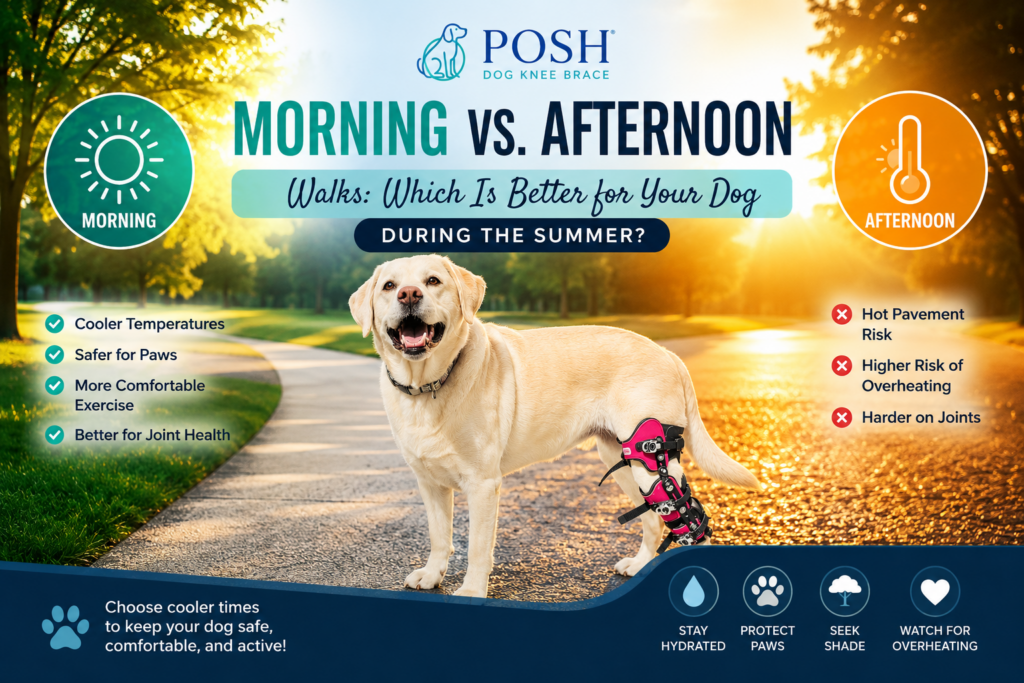
For most dogs, early morning is the safest and healthiest time to exercise during the summer months.
Cooler Temperatures
Temperatures are generally at their lowest shortly after sunrise. Cooler air makes it easier for your dog to breathe comfortably and regulate their body temperature while exercising.
This is especially beneficial for:
Cooler Walking Surfaces
Sidewalks and pavement haven’t yet absorbed hours of sunlight, making them much safer for sensitive paw pads. Cooler surfaces also reduce stress on joints, especially for dogs with arthritis or knee injuries.
More Comfortable Exercise
Dogs tend to have more energy in cooler weather. Morning walks often allow for longer distances and more enjoyable sniffing adventures without the fatigue caused by excessive heat.
Better Mental Stimulation
Starting the day with a walk provides both physical exercise and mental enrichment. Exploring new scents, hearing birds, and interacting with their environment helps reduce boredom and can improve behavior throughout the day.
Afternoons are often the hottest part of the day, making them the least desirable time for outdoor exercise during the summer.
Increased Risk of Heat Exhaustion
As temperatures rise, dogs can quickly overheat. Signs of heat exhaustion include:
If your dog begins showing any of these symptoms, move them immediately to a cool area, offer fresh water, and contact your veterinarian right away.
Hot Pavement Can Burn Paw Pads
Many pet owners underestimate just how hot pavement becomes.
When the air temperature reaches approximately 85°F (29°C), asphalt may exceed 130°F (54°C). At these temperatures, paw pad burns can occur within seconds.
A simple way to test the pavement is the “seven-second test.” Place the back of your hand on the pavement for seven seconds. If it’s too hot for your hand, it’s too hot for your dog’s paws.
Increased Joint Fatigue
Dogs recovering from orthopedic injuries, including ACL or CCL tears, may tire more quickly in hot weather. Heat increases overall fatigue, which can affect coordination and muscle support around injured joints.
Fatigued muscles provide less stability, increasing the risk of slips, awkward movements, or further injury.
Sometimes work schedules or family commitments make afternoon walks necessary. If you must walk your dog during warmer hours, taking a few precautions can make the outing much safer.
Choose shaded routes whenever possible. Parks with tree cover or grassy trails remain cooler than sidewalks or parking lots.
Keep walks shorter than usual. Instead of one long walk, consider several brief potty breaks and save longer exercise sessions for early morning or later in the evening.
Always carry fresh water and offer frequent drinking breaks.
Walk on grass whenever possible instead of asphalt or concrete.
Watch your dog’s body language carefully. Slowing down, excessive panting, seeking shade, or refusing to continue walking are all signs it’s time to head home.
If mornings aren’t possible, evening walks after the sun has begun to set can be another excellent choice.
Before heading out, remember that pavement may still hold heat from the day. Perform the seven-second pavement test before allowing your dog to walk on sidewalks.
Evening walks also provide a relaxing opportunity for dogs to unwind before bedtime and can help reduce excess energy.
Dogs recovering from ACL surgery, wearing a custom knee brace, managing arthritis, or dealing with other mobility conditions require extra attention during the summer.
Heat places additional stress on the cardiovascular system and muscles. As muscles become fatigued, they provide less support for injured joints.
For dogs with knee injuries or arthritis:
Many dogs recovering from orthopedic injuries benefit from maintaining gentle daily activity while avoiding excessive heat that could delay recovery.
Hydration is just as important as timing.
Before every walk:
You can also help your dog stay cool by providing frozen treats, cooling mats, shaded rest areas, or even a quick rinse with cool (not ice-cold) water after outdoor activity.
When it comes to summer walks, timing truly makes a difference.
Morning walks generally provide the coolest temperatures, safer walking surfaces, and the most comfortable conditions for dogs of all ages. Evening walks are another excellent alternative once the day’s heat begins to fade.
Afternoon walks aren’t always avoidable, but they require extra caution, shorter durations, and close attention to your dog’s comfort and safety.
By adjusting your walking routine during the warmer months, you can help prevent heat-related illnesses, protect your dog’s paws, reduce stress on their joints, and ensure they continue enjoying the outdoors all summer long.
A little planning goes a long way toward keeping every walk a safe, healthy, and enjoyable adventure—no matter the season.
If you are interested in a Posh Dog Knee Brace you can contact us via or contact form or check us out on Facebook.
Articles from the Posh Dog Knee Brace team — a group effort with our licensed veterinary technicians and brace specialists, sharing 15+ years of experience helping dogs recover from CCL/ACL injuries and mobility challenges.