Post Published on April 6, 2026
If you’ve ever watched your dog suddenly bolt across the yard, spin in wild circles, and ricochet off the couch like a furry rocket — you’ve witnessed the legendary zoomies. Officially known as Frenetic Random Activity Periods (FRAPs), zoomies are completely normal and usually adorable.
But here’s the question many dog parents quietly worry about:
Can zoomies actually cause an ACL tear in dogs?
Let’s break down what really happens during those high-speed bursts — and what every owner should know to protect their pup’s knees.
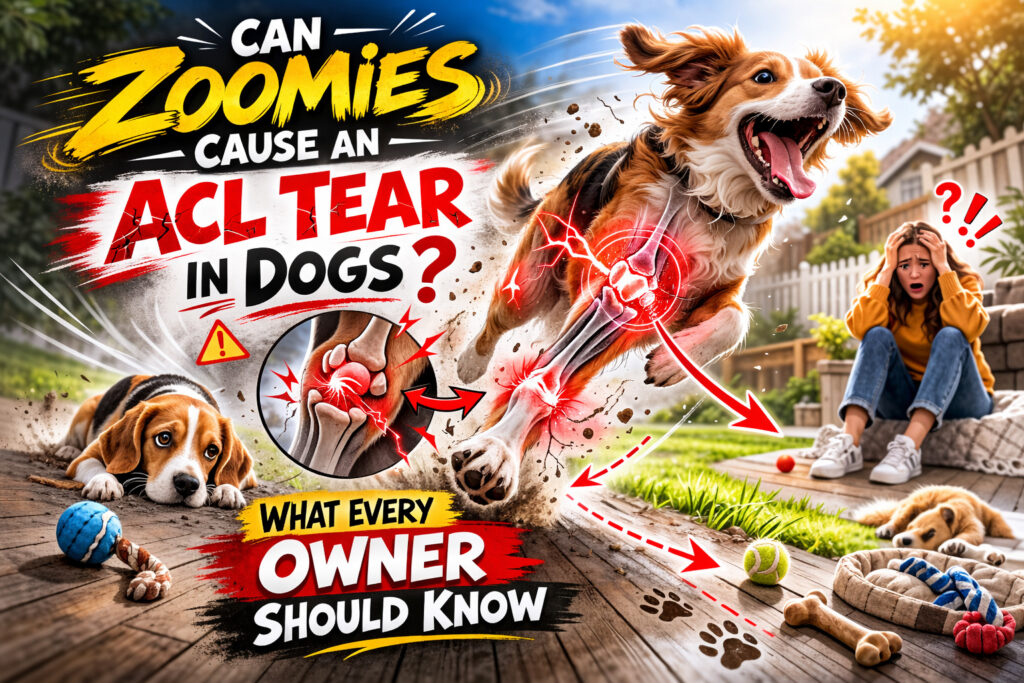
In dogs, the ligament we commonly call the “ACL” is technically known as the cranial cruciate ligament (CCL). It stabilizes the knee joint and prevents the shin bone from sliding forward.
When this ligament tears or ruptures, it causes:
CCL tears are one of the most common orthopedic injuries in dogs.
The short answer: Zoomies alone usually don’t cause a healthy ligament to tear.
However, zoomies can be the moment when a weakened or degenerating ligament finally gives out.
Here’s why:
1. Most CCL Tears Are Degenerative
Unlike human ACL injuries (which are often sudden sports injuries), dogs typically experience slow ligament degeneration over time. The ligament gradually weakens due to:
By the time the ligament tears, it was often already compromised.
2. Zoomies Create Sudden Torque
During zoomies, dogs:
That sudden torque on a weakened knee can be the final straw. It’s not that zoomies are “dangerous” — it’s that they can expose an underlying issue.
Some breeds are more prone to CCL injuries, including:
If you have one of these breeds, it’s especially important to monitor knee health.
Before a full tear, you might notice:
These subtle signs often get dismissed — until a zoomie episode turns into a full rupture.
Absolutely not.
Zoomies are:
But there are smart ways to reduce injury risk.
🐾 1. Maintain Healthy Weight
Excess weight significantly increases strain on the knee joint.
🐾 2. Improve Traction
Slippery floors are a major risk factor. Consider:
🐾 3. Strengthen Supporting Muscles
Strong thigh muscles help stabilize the knee and reduce ligament stress.
🐾 4. Manage High-Impact Surfaces
Hard, uneven terrain increases torque. Grass is generally safer than tile or polished concrete.
🐾 5. Provide Preventative Support
If your dog has shown early instability, structured joint support and stabilization can help protect the knee during activity.
Here’s something many owners don’t realize:
When one CCL tears, the opposite knee has a high likelihood of tearing within 1–2 years.
Why?
Protecting the healthy leg becomes critical after the first injury.
Seek veterinary evaluation immediately if:
Early intervention can prevent further joint damage and arthritis progression.
Zoomies don’t create ACL (CCL) injuries out of nowhere.
But they can be the moment when a weakened ligament finally tears.
Instead of fearing zoomies, focus on:
That way, your dog can keep racing in joyful circles — safely.
If your dog has already experienced a CCL injury or you’re seeing early signs of instability, proactive knee support can make a significant difference in mobility and long-term joint protection.
Because every dog deserves to zoom — without the setback. 🐾 For more information about our brace you can contact us via our contact form or visit us on Facebook.
Articles from the Posh Dog Knee Brace team — a group effort with our licensed veterinary technicians and brace specialists, sharing 15+ years of experience helping dogs recover from CCL/ACL injuries and mobility challenges.