Post Published on April 13, 2026
When you have more than one dog, life is usually full of movement—shared zoomies, backyard wrestling matches, synchronized barking at the mail carrier, and group excitement at the sound of car keys. But when one dog suffers a knee injury, everything changes.
Whether your dog has experienced a cranial cruciate ligament (CCL) tear (often referred to as an ACL injury), had surgery, or is being managed conservatively, your entire household routine needs adjustment. The challenge isn’t just protecting the injured knee—it’s managing energy, space, and interactions so healing can happen safely. If you’re navigating multi-dog life during recovery, here’s how to keep everyone safe and sane.
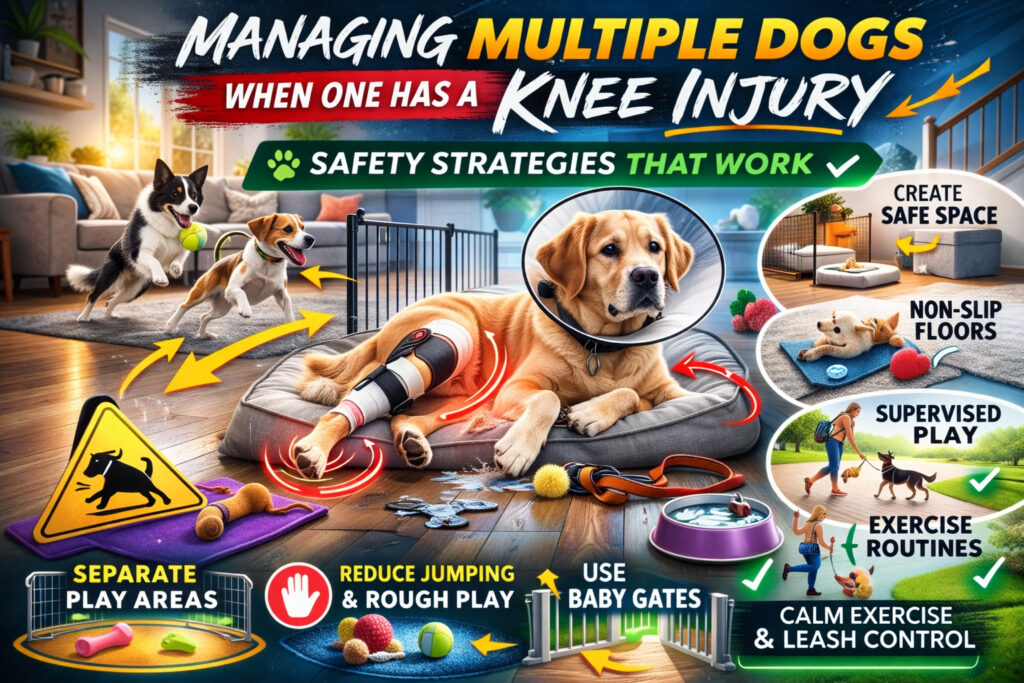
Dogs don’t operate on “light duty” naturally. They communicate and play physically. Even calm dogs can bump, chase, or initiate play without warning.
After common surgical repairs or bracing:
…controlled movement is essential for proper healing.
Unplanned wrestling or sudden chasing can:
In multi-dog households, prevention requires structure—not just hope.
You don’t necessarily need to isolate your injured dog 24/7—but you must manage high-energy moments.
Common trigger times include:
During these times, use:
Prevention is always easier than correcting excitement once it starts.
It may feel excessive, but short-term indoor leash management can be extremely effective.
Keep your recovering dog on a lightweight leash indoors so you can:
If other dogs are excitable, leash them too during shared time. Calm coexistence is the goal—not total separation, but structured interaction.
Even gentle play can escalate quickly.
During knee recovery:
It only takes one pivot or collision to undo weeks of healing.
Instead, provide:
Remember: Physical rest doesn’t mean emotional isolation.
If you have a fenced yard, don’t assume it’s safe for unsupervised group turnout.
Options that work:
Backyard sprints are one of the biggest causes of reinjury. If your other dogs are high-drive breeds, this becomes even more important. Excitement spreads quickly in a group.
Food increases competition and energy.
Best practices:
Guarding behaviors—even mild ones—can trigger sudden lunging.
You want predictability and calm during recovery.
Your injured dog needs a designated safe space.
This area should:
A crate or exercise pen provides structure and safety—especially in early post-op weeks.
The recovery zone isn’t punishment. It’s protection.
Here’s something many owners don’t realize:
Dogs who tear one CCL often injure the other within 1–2 years. Using a Posh Dog Knee Brace can significantly decrease this risk, sometimes by 70%.
In multi-dog households, overcompensation risk increases because:
Protecting the healing leg also protects the opposite knee. Controlled, symmetrical movement is essential.
One common mistake? Letting the entire household energy drop drastically.
Your healthy dogs still need:
If they don’t get it, they’ll redirect that energy toward the recovering dog.
Schedule:
A tired dog is a calm dog—and calm dogs protect healing knees.
Multi-dog households tend to erupt when someone enters the home.
To manage this:
Excited pack greetings can involve jumping, circling, and bumping—all dangerous during recovery.
Calm entrances set the tone.
Recovery is a great time to reinforce impulse control.
Teach:
Structured training strengthens communication and lowers chaos.
Dogs thrive on clarity.
Watch for:
Intervene early.
Don’t wait for escalation.
If you see play energy building, separate before it turns physical.
Until your veterinarian clears full activity, assume that unsupervised time is unsafe.
Even bonded dogs can:
Short-term vigilance prevents long-term setbacks.
When your veterinarian confirms healing progress, don’t immediately return to full-speed play.
Instead:
Muscle strength takes time to rebuild—even after surgical repair.
Healing bone does not equal fully conditioned muscle.
It’s easy to feel guilty separating dogs or limiting activity.
But remember:
You are preventing reinjury.
You are protecting thousands of dollars in surgery.
You are avoiding prolonged pain.
Recovery is temporary. Chronic instability is not.
Dogs sense stress in the household.
Maintain:
Your injured dog needs emotional stability as much as physical rest.
Isolation without interaction can increase anxiety, which leads to restless behavior.
Balance is key.
Managing multiple dogs when one has a knee injury isn’t about isolating the injured dog from the family—it’s about controlling variables during healing.
Success comes from:
Recovery from a CCL injury isn’t just medical—it’s environmental.
Your home becomes part of the treatment plan.
With intentional management, your injured dog can heal properly without creating chaos in the rest of your pack.
And when recovery is complete, your structured leadership may even leave your household calmer and more balanced than before. For more information about our Posh brace you can contact us via our contact form or visit us on Facebook.
Articles from the Posh Dog Knee Brace team — a group effort with our licensed veterinary technicians and brace specialists, sharing 15+ years of experience helping dogs recover from CCL/ACL injuries and mobility challenges.