Post Published on April 20, 2026
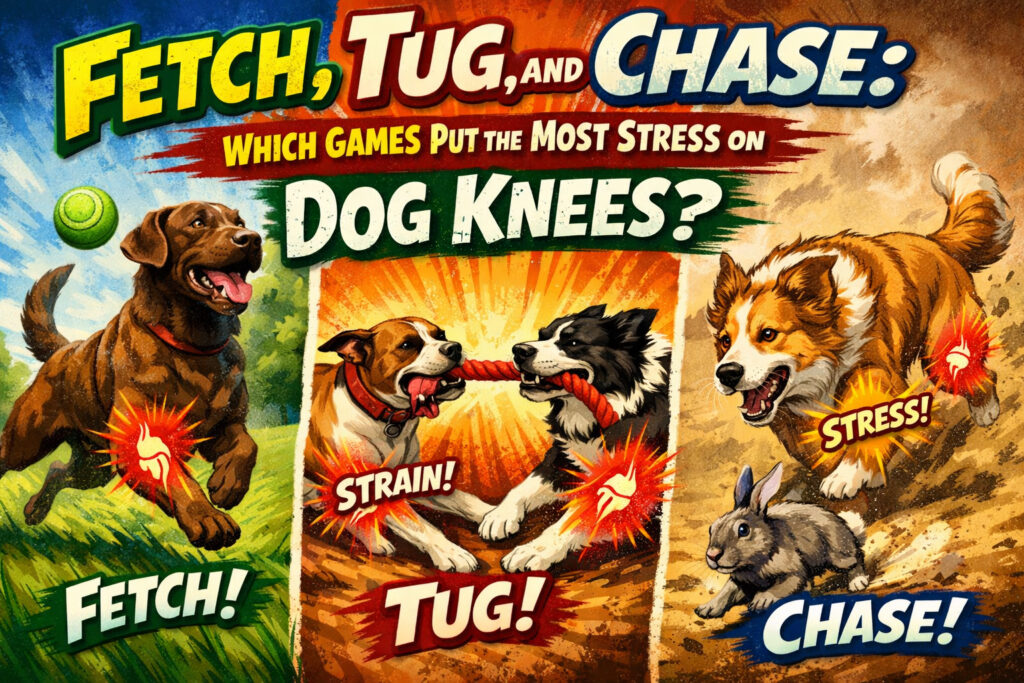
Play is one of the great joys of dog ownership — it builds bond, burns energy, and keeps pups mentally sharp. But some games put more mechanical load on a dog’s stifle (knee) than others, and repeated awkward landings, sudden turns, or sustained strain can increase the chance of injuries such as cranial cruciate ligament (CCL) rupture. Below I break down the three most common play styles — fetch, tug, and chase — explain how each stresses the knee, point to what the research and vets say, and give practical ways to keep play fun and safe.
Large-scale veterinary reviews and studies show that CCL rupture is common and multi-factorial — genetics, body weight, age, and activity type all matter. Fitness and core strength help lower risk, while high-intensity competitive sports (e.g., flyball, some obstacle work) are associated with more stifle injuries.
Fetch often looks harmless, but the main risk to knees comes from jumping and landing. A dog sprinting at full speed, leaping for a ball or frisbee, and then coming down on hard or uneven ground experiences sudden peak vertical forces through hips and stifles. Awkward rotations on landing (if the dog twists to chase or the surface is slippery) are what commonly strain ligaments. Veterinary guidance warns that long, repetitive sessions — or throwing high, erratic throws that force big leaps during fetch — increase the chance of acute or cumulative injury.
How to make fetch safer
Tug-of-war feels intense, but biomechanically it’s different: it’s mostly a pulling-and-holding game, not one full of high jumps or sudden multi-directional turns. That means knees typically take less violent impact compared with fetch or chase. Still, tug has its hazards: sudden lunges, jerking motions, or dogs bracing with legs splayed can put strain on shoulders, necks, and sometimes the stifle — especially if play is rough or if the dog is already injured. Experts recommend playing tug with rules (start/stop cues) and appropriate toys, and avoiding rope toys that fray and can become dangerous if ingested.
How to make tug safer
Chase games (especially those that simulate prey — e.g., someone dashing away while the dog zig-zags after them) can be deceptively risky. The dangerous element isn’t just speed but rapid decelerations and sharp pivots. When a dog makes a high-speed pursuit then suddenly turns or plants to change direction, torsional forces go through the knee — and repeated or extreme pivots are strongly linked to stifle injuries in athletic dogs. Studies of agility and working dogs show that quick turns, landings, and repetitive high-load maneuvers are associated with higher stifle injury rates.
How to make chase safer
If we rank purely on knee stress potential:
That said, risk is contextual. A two-hour unsupervised ball-throwing session on a rock-hard surface can be worse than a five-minute supervised frisbee toss on soft turf. Similarly, a young, unconditioned working-breed sprinting through tight turns is more vulnerable than a fit, adult dog doing the same.
Certain dogs are more likely to suffer stifle injuries: large and giant breeds, overweight dogs, dogs with certain conformational or genetic predispositions, and dogs that are under-conditioned (poor core strength). Conversely, dogs with good conditioning, balanced body weight, and controlled play tend to fare better. A veterinary review and related research emphasize that fitness and core strength reduce ligament tear odds, while some high-intensity sports elevate risk.
If your dog limps, is reluctant to bear weight, shows swelling around the knee, or has sudden changes in activity level after play — pause all strenuous activity and consult your veterinarian. Early evaluation can spot ligament strains before they become full ruptures.
No single game is “always safe” or “always dangerous.” The difference lies in intensity, surface, frequency, the dog’s body, and how you manage play. Chase and repetitive, high-impact fetch jumps carry the most potential to stress a dog’s knees, while tug is typically lower-impact for stifles if played sensibly. Use controlled play, conditioning, and common-sense safeguards to keep the zoomies joyful — and knees intact. For breed- or dog-specific advice, ask your veterinarian; they can assess risk factors and recommend conditioning or alternative activities tailored to your pup.
For more information on how the Posh Brace can support your dog’s recovery and joint health, feel free to reach out via our contact form or visit our Facebook page to see it in action.
Articles from the Posh Dog Knee Brace team — a group effort with our licensed veterinary technicians and brace specialists, sharing 15+ years of experience helping dogs recover from CCL/ACL injuries and mobility challenges.