When your dog tears their ACL (also called the CCL in dogs), it can feel like everything changes overnight. There’s the shock of diagnosis, the worry about surgery, the cost, the recovery timeline — and the hope that once it heals, life will go back to normal.
But here’s the truth many pet parents don’t hear soon enough:
The biggest risk for a second ACL tear isn’t bad luck. It’s waiting too long to make the right changes.
If your dog has already torn one cruciate ligament, the other knee is now at significantly higher risk. Some studies suggest that more than 50% of dogs will tear the opposite ACL within 1–2 years. The good news? Early, proactive lifestyle changes can dramatically reduce that risk.
Let’s talk about the real cost of waiting — and what you can do today to protect your dog’s future mobility.
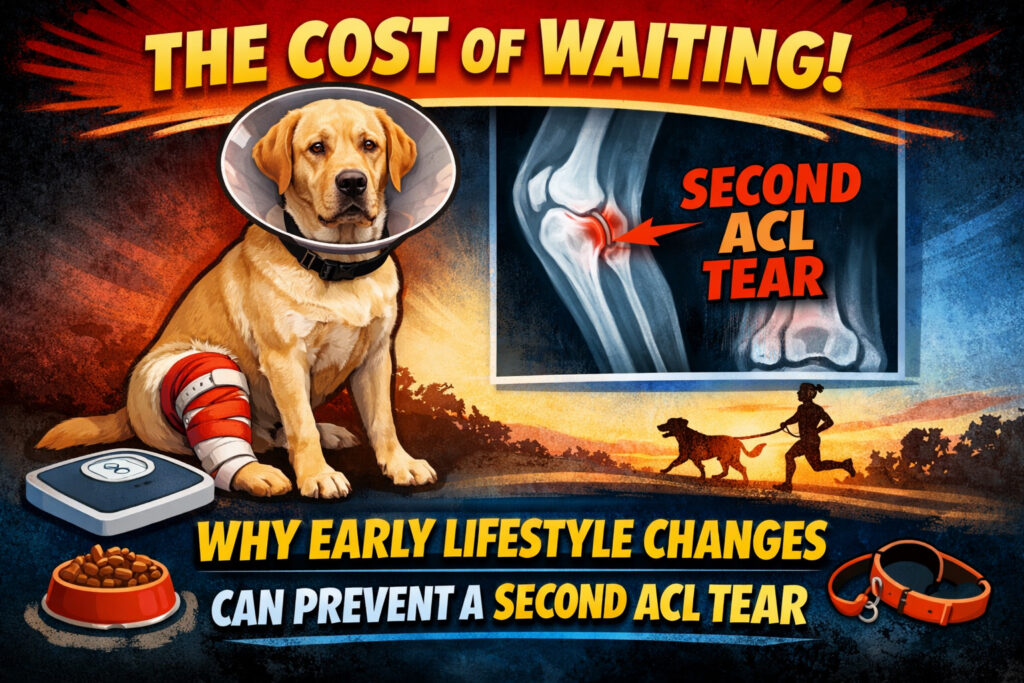
An ACL tear doesn’t just affect one knee. It changes how your dog moves.
After injury:
Even after surgery, subtle compensation patterns often remain. That means the “good” leg is doing more work than it should — sometimes for months.
Over time, that overload can lead to:
The clock doesn’t start ticking when your dog looks better. It starts the day the first injury happens.
Let’s be practical for a moment.
Surgical repair of a canine ACL tear (TPLO, TTA, or lateral suture) can cost anywhere from $3,000 to $7,000 per knee depending on location and surgeon. If both knees require surgery, that cost doubles.
Then there’s:
A second tear isn’t just another injury — it’s another recovery cycle, another confinement period, and another disruption to your dog’s quality of life.
Preventing that second injury isn’t just about money. It’s about avoiding putting your dog through it all again.
Here’s what happens when lifestyle changes are delayed:
1. Muscle Atrophy Gets Worse
After an ACL injury, the affected leg quickly loses muscle mass. If rebuilding strength is slow or inconsistent, the opposite leg absorbs extra load. That imbalance increases strain on the second knee.
2. Weight Gain Sneaks In
During recovery, activity drops. Calories often don’t.
Even a few extra pounds significantly increase pressure on the knees. For every pound of body weight, several pounds of force are transmitted through the joint during movement.
Extra weight = extra ligament stress.
3. Instability Becomes Habitual
If your dog continues jumping off furniture, racing on slippery floors, or pivoting hard during play, micro-damage can accumulate in the second ligament.
Ligaments don’t usually snap without warning. They weaken over time.
Waiting allows small issues to become major injuries.
The most powerful prevention tool is not reactive — it’s proactive. Here are the changes that matter most.
1. Optimize Weight Immediately
Even if your dog looks “fine,” ask your veterinarian to evaluate their body condition score.
A lean body:
A slight calorie adjustment today can prevent thousands of dollars in surgery later.
2. Modify High-Risk Movements
After the first ACL tear, your dog’s days of uncontrolled jumping and hard pivots should be over.
That means:
Install:
These changes are simple — but incredibly effective.
3. Rebuild Balanced Strength
The goal isn’t just healing the surgical leg. It’s building symmetrical strength.
Focus on:
Strong glutes and quadriceps reduce strain on both knees. Skipping this step is one of the biggest contributors to second tears.
4. Support the Joint During Vulnerable Phases
Even after healing, dogs can experience periods of fatigue, minor inflammation, or instability.
Supportive bracing during:
can help reduce strain on the opposite knee while strength builds evenly.
Support is not weakness. It’s strategic protection.
5. Keep Nails Trimmed and Paws Stable
Overgrown nails alter gait mechanics. That subtle shift changes knee alignment and increases ligament strain.
Likewise, dogs who frequently slip on smooth surfaces experience repeated micro-trauma to their joints.
Regular nail trims and traction control inside your home are small habits that make a big difference.
Dogs are masters at hiding discomfort.
By the time you see:
the ligament may already be partially torn.
Waiting for visible signs means you’re already behind. Early prevention happens before symptoms appear.
There’s also the heartbreak factor.
Another crate rest period.
Another round of restricted activity.
Another time saying “not today” to park trips.
Another surgery day.
Dogs thrive on movement and interaction. Multiple long recoveries can affect behavior, mood, and bonding.
Preventing a second tear protects more than knees — it protects your dog’s lifestyle.
Cruciate ligament disease in dogs is often degenerative, not purely traumatic.
That means:
When one ligament tears, it’s often because both were already compromised — one just failed first.
That’s why immediate protective changes are critical.
You’re not just guarding against an accident.
You’re managing an underlying condition.
If your dog has had one ACL tear, here’s your prevention checklist:
Think of it as a new chapter — not a temporary recovery phase.
Waiting costs:
Early lifestyle changes cost far less.
The difference between one ACL surgery and two often comes down to what happens in the months immediately after the first injury.
Your dog’s future mobility isn’t just determined in the operating room.
It’s shaped at home — on your floors, during your walks, in daily habits that either protect or strain that second knee.
The first tear may not have been preventable.
The second one often is.
Make the changes now — not after it happens again. For more information about our brace you can contact us via our contact form or visit us on Facebook.