Post Published on September 21, 2026
When your dog is recovering from an injury, surgery, arthritis, or another mobility issue, physical therapy can play an important role in helping them regain strength, balance, and confidence.
While your veterinarian or canine physical therapist should guide your dog’s specific rehabilitation plan, there are several at-home physical therapy tools for dogs that can make it easier to incorporate safe, gentle exercises into your dog’s daily routine.
From therapy balls to balance equipment, these products can help turn part of your home into a comfortable rehabilitation space.
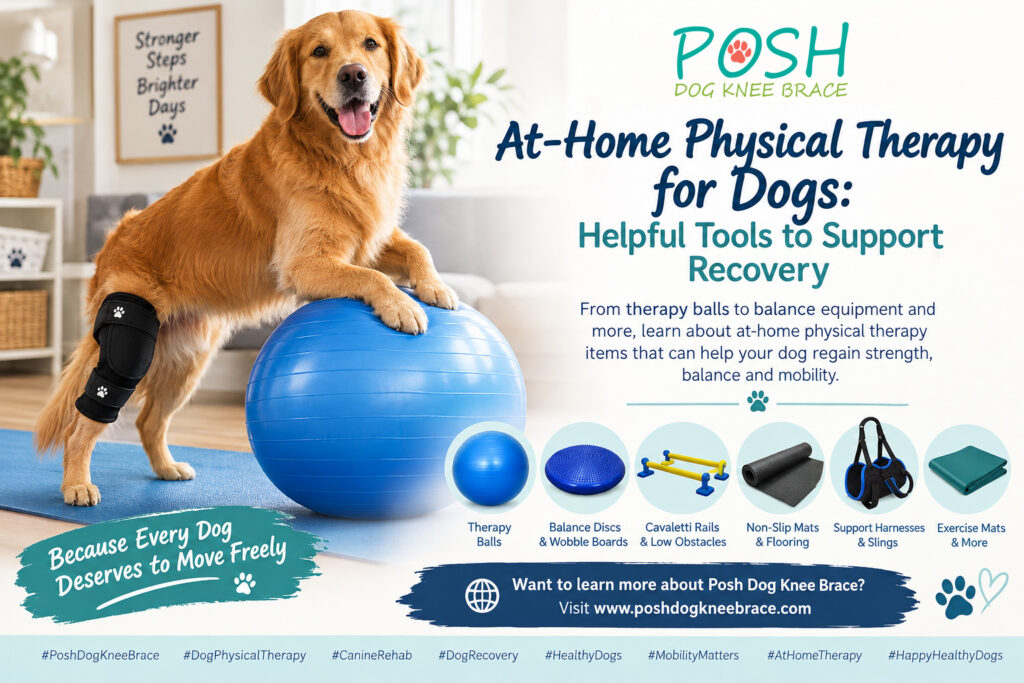
Dogs recovering from knee injuries, ligament problems, arthritis, or other orthopedic conditions may experience muscle weakness and reduced range of motion.
After a period of reduced activity, the muscles supporting the affected leg can become weaker. Gentle, controlled exercises may help support:
The key is to start slowly and follow the exercise recommendations provided by your veterinarian or canine rehabilitation professional.
One of the most popular pieces of home rehabilitation equipment is a dog physical therapy ball, sometimes called a canine exercise ball or balance ball.
These large, sturdy exercise balls can be used for carefully supervised balance and strengthening exercises. Depending on your dog’s condition and rehabilitation plan, exercises may involve standing with the front or rear legs supported on the ball or performing controlled weight-shifting movements.
A therapy ball may help challenge your dog’s:
Because dogs can easily lose their balance, safety is extremely important. Always use an appropriately sized, durable ball on a non-slip surface and stay right beside your dog during exercises.
If your dog has recently had surgery or has a significant injury, ask your veterinarian or rehabilitation therapist when this type of exercise is appropriate.
Balance discs and canine wobble boards are another option for dogs working on stability and body awareness.
These tools create an unstable surface that encourages a dog to engage their muscles to maintain balance. A rehabilitation professional can show you exercises that are appropriate for your dog’s current ability.
Balance equipment can be particularly useful as your dog progresses through rehabilitation, but it isn’t necessarily appropriate during every stage of recovery.
Cavaletti exercises use low rails or obstacles that a dog carefully steps over.
These exercises can encourage controlled movement and help your dog become more aware of where they are placing their feet.
You don’t necessarily need expensive equipment to get started. With guidance from your dog’s rehabilitation professional, appropriately positioned low obstacles can sometimes be incorporated into a home exercise routine.
The goal should be slow, controlled movement — not jumping or rushing.
One of the simplest and most useful things you can add to your home is something many people overlook: secure footing.
Hardwood, tile, and other slippery surfaces can be challenging for dogs with weak legs or mobility problems. Non-slip rugs, rubber-backed mats, or other stable flooring can help give your dog more confidence when walking around the house.
Consider placing non-slip surfaces in areas where your dog frequently gets up, lies down, eats, drinks, or walks.
A properly designed support harness or sling can help provide assistance when your dog needs help standing, walking, or navigating certain areas of the home.
These products can be particularly useful for dogs that are temporarily weak after surgery or an injury.
However, support equipment should be used correctly. Your veterinarian or rehabilitation professional can demonstrate how to support your dog without placing unnecessary stress on an injured limb.
A thick, supportive exercise mat can provide a comfortable and stable surface for rehabilitation exercises.
Look for a mat that provides good traction and doesn’t slide across the floor when your dog moves.
A dedicated exercise area can also help make rehabilitation part of your dog’s daily routine.
Depending on your dog’s condition, your veterinary rehabilitation professional may recommend gentle massage or passive range-of-motion exercises.
Some pet owners use massage tools or their hands to help with relaxation and muscle comfort.
It’s important to learn the proper techniques before working around an injured or recently operated area. Never force a joint through a movement or continue an exercise that causes your dog pain.
While physical therapy products can be helpful, rehabilitation is about much more than having the right equipment.
Your dog’s recovery may also involve:
Every dog is different, and the right rehabilitation program depends on the underlying condition, age, size, activity level, and stage of recovery.
For dogs dealing with knee instability or certain orthopedic conditions, a properly fitted knee brace may be another option to discuss with your veterinarian.
A canine knee brace can provide external support while your dog is moving and participating in appropriate activities. Depending on the individual dog and condition, a brace may be incorporated into a broader mobility and rehabilitation plan.
At Posh Dog Knee Brace, we focus on custom dog knee braces designed to provide support for dogs experiencing knee-related mobility challenges.
A knee brace is not a replacement for veterinary care or a rehabilitation program. Instead, it can be one part of a comprehensive approach to helping your dog stay mobile and supported.
You don’t need to turn your entire house into a physical therapy clinic.
Start by creating a small, safe area where your dog can perform approved exercises without slipping or getting distracted. Keep frequently used items nearby, and make sure the area is free from furniture or objects your dog could bump into.
Most importantly, follow the exercise plan provided by your dog’s veterinarian or canine rehabilitation professional.
More exercise isn’t always better. Recovery is about performing the right exercises at the right time and gradually progressing as your dog becomes stronger.
Recovering from an injury can be a long process, but small, consistent efforts can make a big difference in your dog’s daily mobility and quality of life.
Physical therapy balls, balance equipment, non-slip mats, support harnesses, and other rehabilitation products can be useful tools for an appropriate at-home exercise program.
And if your dog is struggling with knee instability, a custom knee brace may be another option worth discussing with your veterinary care team.
If you’re looking for more information about how a Posh Dog Knee Brace may fit into your dog’s mobility and rehabilitation plan, we’d love to help.
Visit www.PoshDogKneeBrace.com to learn more about Posh Dog Knee Brace and get more information about custom knee brace options for your dog, or check us out on Facebook. Your dog’s journey to better mobility starts with the right support, the right plan, and plenty of patience.
Articles from the Posh Dog Knee Brace team — a group effort with our licensed veterinary technicians and brace specialists, sharing 15+ years of experience helping dogs recover from CCL/ACL injuries and mobility challenges.