If your dog has suffered a torn ACL (more accurately called a CCL — cranial cruciate ligament), you already know how heartbreaking it is to watch them limp, struggle to stand, or hesitate before jumping onto the couch. But what many pet parents don’t realize is this:
The first ACL tear dramatically increases the risk of a second tear in the opposite leg.
In fact, studies estimate that 40–60% of dogs who tear one CCL will tear the other within 1–2 years. Why does this happen? The answer lies in how dogs instinctively protect an injured leg — and how that compensation creates dangerous strain elsewhere.
Let’s break down what’s happening inside your dog’s body and what you can do to reduce the risk of an injured leg.

In dogs, the ACL is technically called the cranial cruciate ligament (CCL). It sits inside the stifle joint (the canine version of the knee) and helps:
When this ligament partially or fully tears, the joint becomes unstable. That instability causes inflammation, pain, and progressive arthritis if not managed properly.
Dogs are masters of adaptation. Unlike humans, they don’t understand “rest this leg for 6 weeks.” Instead, they shift their weight automatically to avoid discomfort.
This protective response is called compensatory weight shifting.
When one hind leg hurts, your dog will:
At first glance, this seems smart — and it is. In the short term, compensation reduces pain.
But in the long term, it creates a biomechanical imbalance.
Here’s where the risk begins.
1. Increased Load on the Opposite Leg (Injured Leg)
When your dog shifts weight away from the injured leg, the opposite hind leg absorbs significantly more force than it was designed to handle.
Think of it like driving a car with one worn tire — the other tire now bears more stress.
Over time:
If the second ligament was already slightly weakened (which is common), the added strain may push it past its breaking point.
2. Underlying Degeneration Is Often Bilateral
Many CCL tears are not caused by sudden trauma. They’re caused by degenerative ligament disease, which often affects both knees.
That means when one ligament tears, the other is usually already compromised — just not yet ruptured.
Compensation simply speeds up what was already developing.
3. Muscle Imbalance Worsens Instability
When a dog protects one injured leg:
Strong muscles help stabilize the knee. When muscle balance disappears, joint stability decreases — increasing strain on both ligaments.
4. Altered Gait Mechanics Increase Shear Forces
The CCL’s main job is preventing the tibia from sliding forward during weight bearing.
When a dog shifts weight unevenly:
It only takes one awkward movement — jumping off the couch, slipping on tile, or turning sharply — for the second ligament to tear.
While every dog is different, research suggests:
Breeds commonly affected include:
But any dog can develop bilateral CCL disease.
Because dogs are good at hiding pain, the second tear often seems “sudden.” In reality, warning signs may have been present.
Watch for:
If your dog had one ACL tear and you notice these signs, don’t ignore them. Early support can make a difference.
After the first ACL tear — whether surgically repaired or managed conservatively — many owners focus solely on healing that leg.
But if nothing is done to:
…the second ligament remains vulnerable. Protection must be proactive, not reactive.
1. Weight Management Is Critical
Even a few extra pounds dramatically increase joint pressure.
Studies show that overweight dogs are far more likely to experience bilateral CCL tears. Maintaining lean body condition reduces mechanical strain on both knees.
2. Improve Traction at Home
Slipping is a major risk factor.
Consider:
Every slip places shear force on the ligament.
3. Controlled Activity — Not Total Inactivity
Too much activity is risky.
Too little activity leads to muscle loss.
Instead:
Balanced muscle support protects the joint.
4. Provide Strategic Joint Support
Supporting the injured leg is important — but so is protecting the opposite leg.
External stabilization can:
Providing structured support during recovery may reduce stress placed on the “good” leg.
Whether a dog undergoes TPLO, TTA, lateral suture surgery, or conservative care, the second knee remains at risk.
Surgery stabilizes the repaired knee — but it does not eliminate:
This is why many veterinarians counsel owners about the high likelihood of the opposite knee eventually tearing.
The key takeaway?
Rehabilitation and joint protection matter regardless of treatment path.
For many families, the second tear feels worse than the first.
You’ve already:
Hearing that the other knee is now torn can feel overwhelming. But understanding why it happens removes some of the mystery — and empowers you to take preventative action early.
It’s helpful to reframe ACL tears not as a one-time injury, but as part of a broader degenerative condition affecting both knees.
That means:
Prevention isn’t about stopping your dog from living.
It’s about helping them move safely and confidently.
If your dog has already torn one ACL:
If your dog hasn’t torn a ligament but is in a high-risk breed or showing early stiffness, proactive support is even more powerful.
Dogs protect an injured leg because they’re smart and adaptive. But that same protective instinct can overload the opposite knee and accelerate a second ACL tear.
Understanding the biomechanics behind compensation gives you an advantage.
The goal isn’t to eliminate risk completely — that’s rarely possible.
The goal is to:
With the right awareness and proactive care, you can significantly lower the chances that one ACL tear turns into two.
And that means fewer surgeries, less pain, and more confident movement for your dog — for years to come.
If you’re interested in learning more about a Posh Dog Knee Brace and how it may help support your dog’s knee during recovery, or injured leg please visit our contact form to get in touch with us. You can also follow us and connect with us on Facebook for helpful tips, updates, and information about canine knee health. We’re here to help you and your dog every step of the way!
If your dog explodes through the front door like they’ve just been released from a starting gate, you’re not alone.
Doorway launches — that full-speed burst from a standstill — are one of the most overlooked risk factors for knee injuries in dogs.
It looks harmless.
It feels normal.
But biomechanically? It’s one of the highest-stress movements your dog performs.
Let’s break down why.
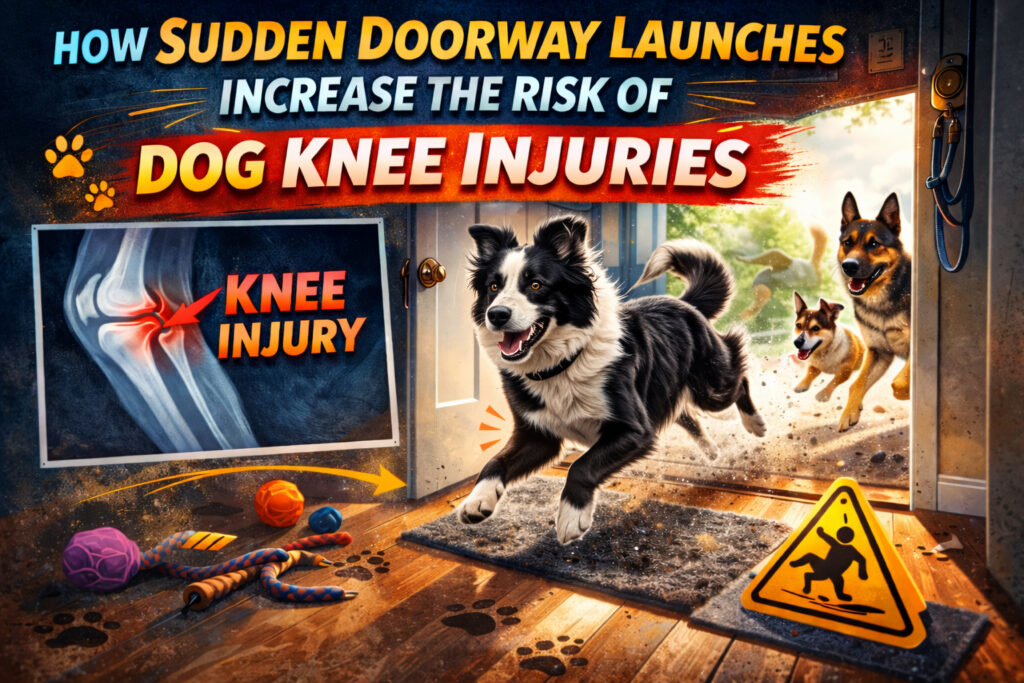
When your dog bolts through a doorway, several things happen at once:
This creates torsion + forward thrust + impact load — the exact combination that stresses the cranial cruciate ligament (CCL), commonly called the ACL in dogs.
The cranial cruciate ligament (CCL) stabilizes your dog’s knee joint and prevents the tibia from sliding forward.
Unlike humans, dogs rarely tear this ligament from a single dramatic event. Most tears are degenerative, meaning the ligament weakens over time.
A sudden doorway launch can be the moment that weakened ligament finally ruptures.
1. Hard, Slippery Surfaces
Entryways are often tile, hardwood, or sealed concrete — all low-traction surfaces.
If the rear foot slips even slightly during push-off, torque increases dramatically at the knee.
2. Sharp Direction Changes
Many dogs don’t run straight out the door. They:
That quick pivot multiplies strain on the CCL.
3. Explosive Push-Off
From a biomechanical standpoint, launching from a stationary stance generates more force than steady acceleration.
It’s similar to a human basketball player jumping into a sprint from a dead stop.
While any dog can experience a knee injury, higher-risk groups include:
Structure, genetics, and body weight all play a role.
Before a full tear occurs, you may notice:
These signs often appear weeks or months before a full rupture.
Here’s what many dog owners don’t realize:
After one CCL tear, the opposite knee has a significant chance of tearing within 1–2 years.
Why?
Because your dog shifts weight to compensate, increasing stress on the “good” leg — especially during high-impact movements like doorway launches.
You don’t have to eliminate excitement — just manage it strategically.
🐾 1. Train a “Wait” Command at the Door
Teaching impulse control reduces explosive launches and protects joints.
🐾 2. Improve Traction
Add:
Better grip = less torque on the knee.
🐾 3. Maintain Ideal Weight
Extra pounds dramatically increase joint stress during acceleration.
🐾 4. Build Controlled Muscle Strength
Strong quadriceps and hamstrings help stabilize the knee and absorb force.
🐾 5. Consider Preventative Support
If your dog shows early instability or has already injured one knee, proactive support can help protect the joint during high-risk movements.
Seek veterinary evaluation if your dog:
Early diagnosis can reduce long-term arthritis progression and joint damage.
Sudden doorway launches may seem harmless, but they combine:
For a healthy ligament, that may not be a problem.
For a weakened one, it can be the tipping point.
The goal isn’t to eliminate your dog’s excitement. It’s to channel it safely.
A few small adjustments at the doorway can protect your dog’s knees — and help keep those joyful sprints injury-free for years to come. 🐾
For more information about our Posh Dog Knee Brace you can contact us via our contact form or visit us on Facebook.
Summer is one of the best seasons to spend quality time outdoors with your dog. Longer days, sunny weather, and more opportunities for adventure make it tempting to head outside whenever you have free time. However, when temperatures rise, choosing the right time of day for a walk becomes more than just a matter of convenience—it becomes a matter of your dog’s health and safety.
Whether your dog is a playful puppy, an energetic adult, a senior companion, or recovering from an ACL injury or arthritis, understanding the difference between morning and afternoon walks can help prevent overheating, protect sensitive paw pads, and reduce stress on their joints.
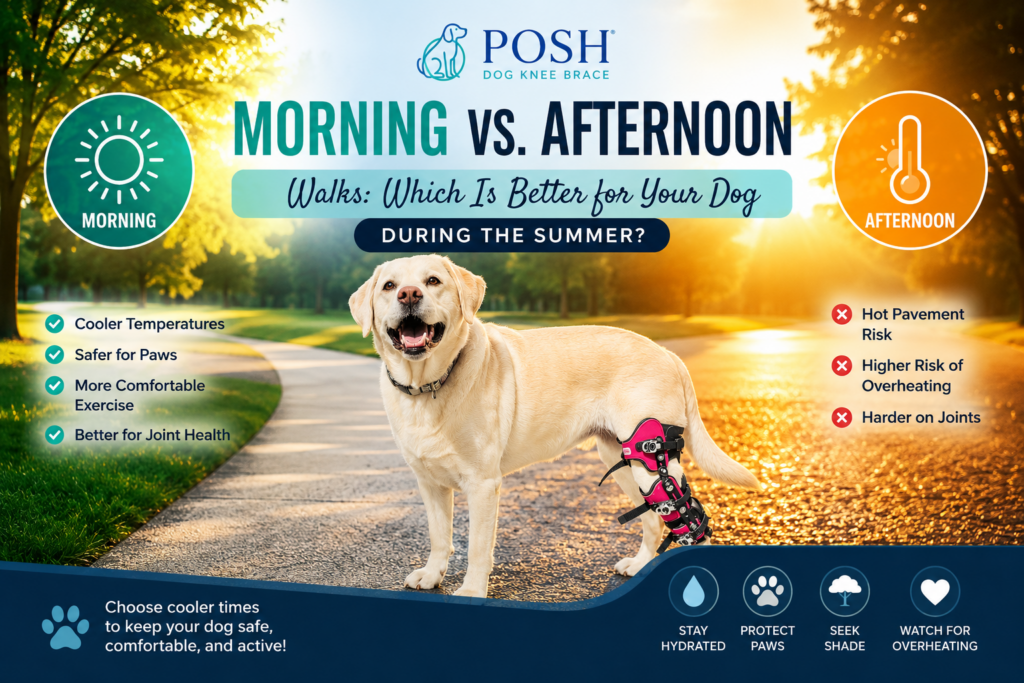
Dogs don’t regulate body temperature the same way humans do. While people cool themselves by sweating, dogs primarily rely on panting and releasing small amounts of heat through their paw pads. When outdoor temperatures climb, especially with high humidity, it becomes much harder for dogs to cool themselves effectively.
What many pet owners don’t realize is that the air temperature isn’t the only concern. Asphalt, concrete, and sidewalks absorb heat throughout the day and can become much hotter than the surrounding air. Even when the weather feels comfortable to you, the ground beneath your dog’s paws may be hot enough to cause burns or discomfort.
Choosing the right time to walk can significantly reduce these risks.
For most dogs, early morning is the safest and healthiest time to exercise during the summer months.
Cooler Temperatures
Temperatures are generally at their lowest shortly after sunrise. Cooler air makes it easier for your dog to breathe comfortably and regulate their body temperature while exercising.
This is especially beneficial for:
Cooler Walking Surfaces
Sidewalks and pavement haven’t yet absorbed hours of sunlight, making them much safer for sensitive paw pads. Cooler surfaces also reduce stress on joints, especially for dogs with arthritis or knee injuries.
More Comfortable Exercise
Dogs tend to have more energy in cooler weather. Morning walks often allow for longer distances and more enjoyable sniffing adventures without the fatigue caused by excessive heat.
Better Mental Stimulation
Starting the day with a walk provides both physical exercise and mental enrichment. Exploring new scents, hearing birds, and interacting with their environment helps reduce boredom and can improve behavior throughout the day.
Afternoons are often the hottest part of the day, making them the least desirable time for outdoor exercise during the summer.
Increased Risk of Heat Exhaustion
As temperatures rise, dogs can quickly overheat. Signs of heat exhaustion include:
If your dog begins showing any of these symptoms, move them immediately to a cool area, offer fresh water, and contact your veterinarian right away.
Hot Pavement Can Burn Paw Pads
Many pet owners underestimate just how hot pavement becomes.
When the air temperature reaches approximately 85°F (29°C), asphalt may exceed 130°F (54°C). At these temperatures, paw pad burns can occur within seconds.
A simple way to test the pavement is the “seven-second test.” Place the back of your hand on the pavement for seven seconds. If it’s too hot for your hand, it’s too hot for your dog’s paws.
Increased Joint Fatigue
Dogs recovering from orthopedic injuries, including ACL or CCL tears, may tire more quickly in hot weather. Heat increases overall fatigue, which can affect coordination and muscle support around injured joints.
Fatigued muscles provide less stability, increasing the risk of slips, awkward movements, or further injury.
Sometimes work schedules or family commitments make afternoon walks necessary. If you must walk your dog during warmer hours, taking a few precautions can make the outing much safer.
Choose shaded routes whenever possible. Parks with tree cover or grassy trails remain cooler than sidewalks or parking lots.
Keep walks shorter than usual. Instead of one long walk, consider several brief potty breaks and save longer exercise sessions for early morning or later in the evening.
Always carry fresh water and offer frequent drinking breaks.
Walk on grass whenever possible instead of asphalt or concrete.
Watch your dog’s body language carefully. Slowing down, excessive panting, seeking shade, or refusing to continue walking are all signs it’s time to head home.
If mornings aren’t possible, evening walks after the sun has begun to set can be another excellent choice.
Before heading out, remember that pavement may still hold heat from the day. Perform the seven-second pavement test before allowing your dog to walk on sidewalks.
Evening walks also provide a relaxing opportunity for dogs to unwind before bedtime and can help reduce excess energy.
Dogs recovering from ACL surgery, wearing a custom knee brace, managing arthritis, or dealing with other mobility conditions require extra attention during the summer.
Heat places additional stress on the cardiovascular system and muscles. As muscles become fatigued, they provide less support for injured joints.
For dogs with knee injuries or arthritis:
Many dogs recovering from orthopedic injuries benefit from maintaining gentle daily activity while avoiding excessive heat that could delay recovery.
Hydration is just as important as timing.
Before every walk:
You can also help your dog stay cool by providing frozen treats, cooling mats, shaded rest areas, or even a quick rinse with cool (not ice-cold) water after outdoor activity.
When it comes to summer walks, timing truly makes a difference.
Morning walks generally provide the coolest temperatures, safer walking surfaces, and the most comfortable conditions for dogs of all ages. Evening walks are another excellent alternative once the day’s heat begins to fade.
Afternoon walks aren’t always avoidable, but they require extra caution, shorter durations, and close attention to your dog’s comfort and safety.
By adjusting your walking routine during the warmer months, you can help prevent heat-related illnesses, protect your dog’s paws, reduce stress on their joints, and ensure they continue enjoying the outdoors all summer long.
A little planning goes a long way toward keeping every walk a safe, healthy, and enjoyable adventure—no matter the season.
If you are interested in a Posh Dog Knee Brace you can contact us via or contact form or check us out on Facebook.
As dog parents, we pour so much love into our pups. From picking the best kibble to scheduling those regular vet check-ups, we’re always looking for ways to keep them happy and healthy. But there’s one part of the fitness routine that often gets skipped—especially before a big adventure: the warm-up.
Think about it: if you were going to run a marathon or hit the gym for a heavy lifting session, you wouldn’t jump straight off the couch and start sprinting, right? You’d stretch and get your blood moving first. Yet, we often do exactly that to our dogs, taking them from a deep snooze to an intense game of fetch or a high-energy hike in seconds flat.
It’s a simple oversight, but it can lead to strains, sprains, or even bigger orthopedic issues down the road. Let’s change that! Here is your guide to keeping your dog limber, happy, and ready for action.
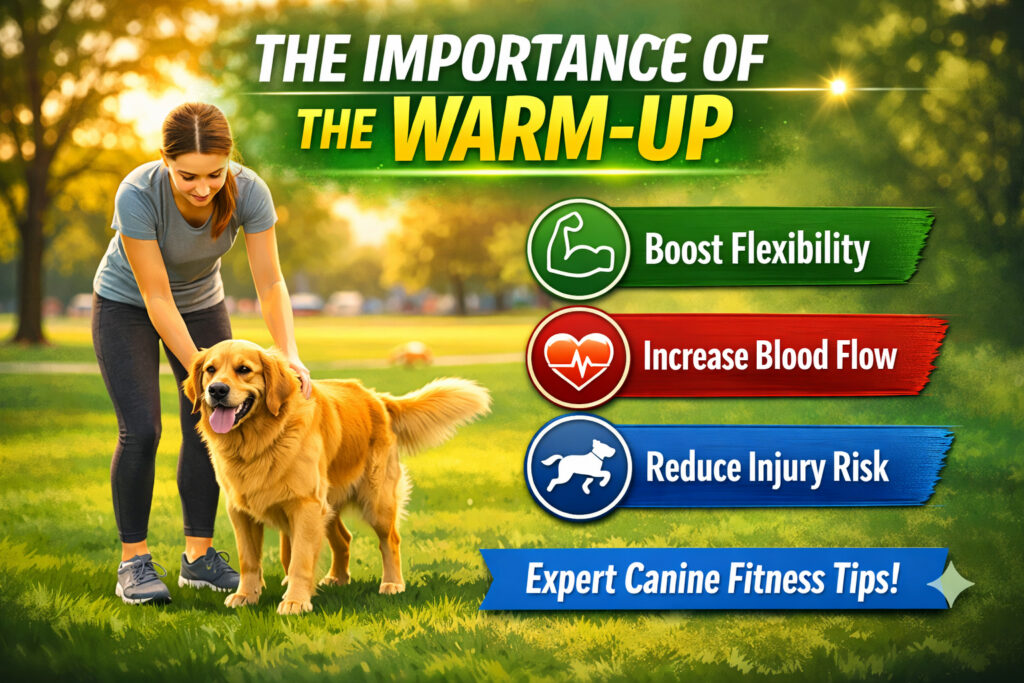
A warm-up isn’t just “extra” work—it’s a simple preventative measure that sets your dog up for success. Here’s why it matters:
You don’t need to be an expert to do this. A good warm-up lasts about 5–10 minutes and has two easy steps: Dynamic Movement and Gentle Stretching.
Pro tip: Only do these once your dog is moving. Never force a stretch—if your dog seems uncomfortable, skip it!
It only takes 5-10 minutes, but it makes a lifetime of difference. By adding a little warm-up to your routine, you’re protecting your dog’s joint health and ensuring they stay your active, adventurous partner for as many years as possible.
If you are interested in a Posh Dog Knee Brace you can contact us via our contact form or check out our Facebook page.
Summer is synonymous with sun-soaked adventures, and for many dog owners, that means heading straight to the coast. But when your dog is recovering from a knee injury—such as a CCL tear or recent orthopedic surgery—the beach can transform from a paradise into a minefield of unstable terrain and overheating risks.
Does this mean you have to skip the beach entirely? Not necessarily. With the right strategy, you can still enjoy a refreshing coastal getaway without compromising your dog’s recovery. The key is shifting your mindset from a high-energy “adventure day” to a structured, “low-impact” beach experience.
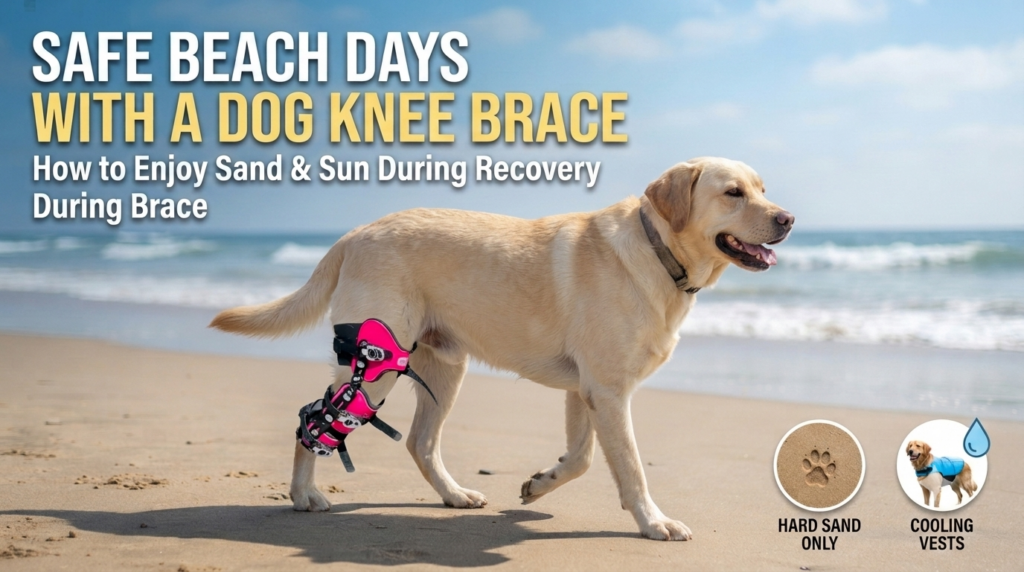
The biggest hidden danger for a dog with a knee brace isn’t the water or the heat—it’s the sand itself.
Before you even leave the car, take a moment to scout the entry point. If the path to the water requires navigating deep dunes, you may need to carry your dog or use a supportive harness with a handle to assist them over the uneven terrain.
When a dog wears a knee brace, they are already dealing with an added layer of neoprene or fabric covering a significant portion of their leg. Add the summer sun and the radiant heat reflecting off the sand, and your dog is at a much higher risk of overheating.
Panting is your dog’s primary way of cooling down, but it isn’t always enough in extreme humidity or direct sunlight. This is where a dog cooling vest becomes an essential piece of medical gear rather than just an accessory.
Cooling vests work through evaporative cooling. When you soak the vest in cool water and wring it out, the specialized fabric holds onto the moisture. As the water evaporates, it draws heat away from your dog’s body, keeping their core temperature stable.
A successful beach day with a recovering pup is all about short bursts of activity followed by long periods of rest.
By choosing firm ground, prioritizing shade, and utilizing cooling technology, you can navigate the summer safely. Remember, the goal of this outing is bonding and relaxation, not rigorous exercise. Keep it slow, keep it cool, and your dog will thank you for it.
If you are interested in a Posh Dog Knee Brace to help your canine companion recover safely and comfortably, we are here to support you. You can reach out to our team directly through our website’s contact form, or connect with us on Facebook for more tips, updates, and community support.
When your dog is recovering from an ACL injury (also known as a CCL tear), even simple, everyday tasks can suddenly feel overwhelming. One of the most common challenges pet parents face is helping their dog get in and out of the car safely.
Whether you’re heading to a vet follow-up, physical therapy appointment, or just taking a short ride, improper movement during car entry or exit can delay healing—or worse, cause re-injury. The good news? With the right approach and a little preparation, you can protect your dog’s knee and make car rides safe again.
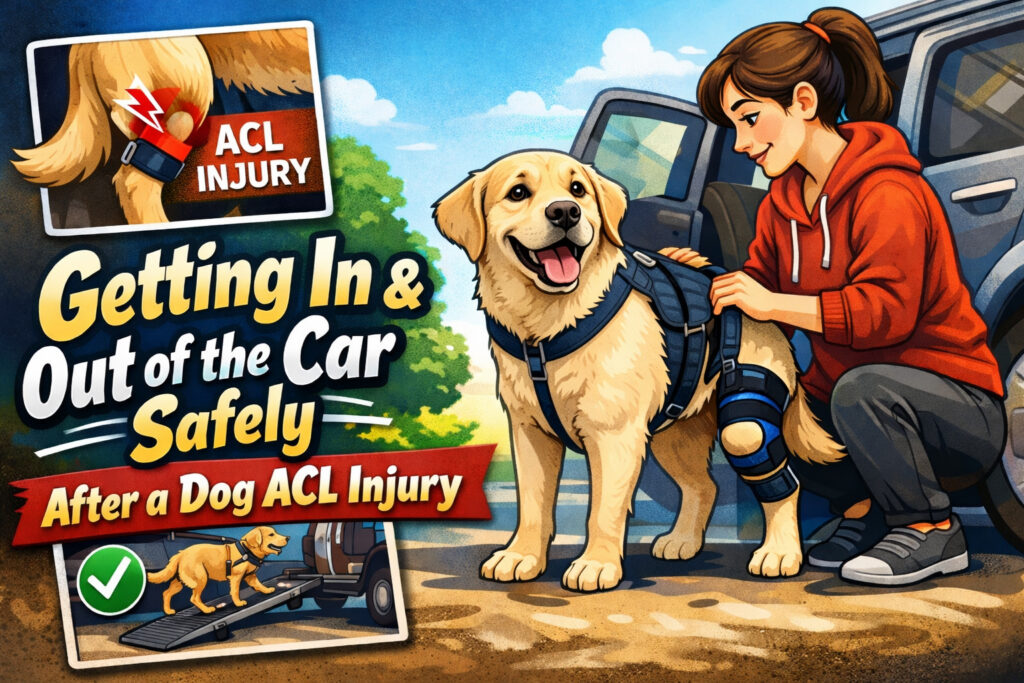
The canine ACL is properly called the cranial cruciate ligament (CCL). It plays a critical role in stabilizing your dog’s knee joint. When it tears—partially or completely—it causes pain, instability, and inflammation.
In many cases, dogs undergo surgical repair such as:
Others may follow a conservative management plan depending on size, severity, and veterinarian recommendations.
Regardless of the treatment route, one rule remains the same: controlled, supported movement is critical during recovery. Jumping in and out of a vehicle is one of the riskiest uncontrolled movements a healing dog can make.
Before injury, most dogs launch themselves into vehicles without hesitation. After a CCL tear, that same motion creates:
Even after surgery, the internal structures are still healing for weeks. The bone needs time to fuse (in surgical cases), and surrounding muscles must rebuild strength.
One bad jump can:
That’s why controlled entry and exit isn’t optional—it’s essential.
The golden rule: No jumping. At all.
This applies to:
Even if your dog looks better, ligament healing and bone remodeling take time. Always follow your veterinarian’s timeline before allowing independent movement.
A ramp is one of the safest and most effective tools during ACL recovery.
Why ramps are ideal:
What to look for:
Take time to train your dog to use the ramp slowly. Use treats, calm praise, and a leash for stability.
Pro tip: Always support with a harness while your dog walks up or down, especially during the first few weeks.
A rear-support harness (sometimes called a recovery sling) allows you to assist your dog’s back end as they move.
This is especially helpful for:
The harness allows you to:
Never lift by the collar or under the abdomen alone—this can create additional stress or discomfort.
Once inside, your dog’s safety isn’t finished.
Car interiors can be slippery. Leather seats, plastic cargo areas, and loose blankets can all cause sliding, which twists the healing knee.
Safer setup:
For smaller dogs, a secure travel crate may offer the most stability during healing.
Most dogs are more excited getting out of the car than getting in. That burst of energy can cause sudden jumping.
Before opening the door:
Never open the hatch and allow your dog to bolt. Descending creates even more strain than going up, because gravity adds impact force to the knee joint.
Dogs recovering from ACL surgery fatigue faster than usual. Muscle atrophy happens quickly during restricted activity.
Signs your dog may need more support:
If you notice this, increase support during car transfers and shorten outings.
Studies show that many dogs who tear one CCL will eventually injure the other. Overcompensation plays a big role.
When helping your dog in and out of the car:
Your goal is symmetry and slow movement.
Preparation reduces stress—for both of you.
Before leaving:
If possible, avoid high-clearance vehicles during recovery. Even backing up to a curb to reduce height can help.
Even small dogs shouldn’t jump after an ACL injury. While it may look less dramatic, their knees experience the same biomechanical stress relative to their body size.
Use:
Never allow repetitive small jumps, such as hopping from seat to seat.
This depends on:
For surgical repairs like TPLO or TTA, many dogs require strict movement control for 8–12 weeks.
Some dogs—especially large breeds—benefit from using ramps permanently to reduce long-term joint stress.
Contact your veterinarian if you notice:
Early intervention prevents setbacks.
Car rides often mean something exciting—parks, family visits, adventures. After injury, your dog may associate car entry with discomfort.
Stay calm. Move slowly. Keep experiences positive but controlled.
Your energy influences theirs.
ACL recovery isn’t just about surgery or rest—it’s about the hundreds of small movements your dog makes every day.
Getting in and out of the car may seem minor, but it’s one of the highest-risk moments during healing. Eliminating jumping, adding support, and planning ahead dramatically reduce complications.
The goal isn’t just short-term healing.
It’s long-term joint health, confidence, and mobility.
With patience, preparation, and smart tools, you can safely navigate car rides and keep your dog on track toward a strong, stable recovery.
If you are interested in a posh dog knee brace you can contact us via our contact form or check out our facebook page.
As devoted dog parents, we constantly look for ways to keep our furry family members happy, healthy, and comfortable. Often, we focus on diet, exercise, and regular vet check-ups. But what about the repetitive strain of everyday movements that can silently damage their joints? We’re talking about stairs, jumping on and off furniture, and getting in and out of the car, ramps should be something to think about.
While these might seem like minor activities, the cumulative impact of repeated high-impact movements can significantly contribute to joint issues over time, particularly for breeds prone to hip and elbow dysplasia, patellar luxation, or those recovering from injuries like ACL tears.
Enter the humble yet mighty dog ramp. More than just a convenience, a dog ramp is a preventative and rehabilitative tool that can genuinely extend your dog’s comfort and mobility, protecting their precious knees and hips from unnecessary strain.
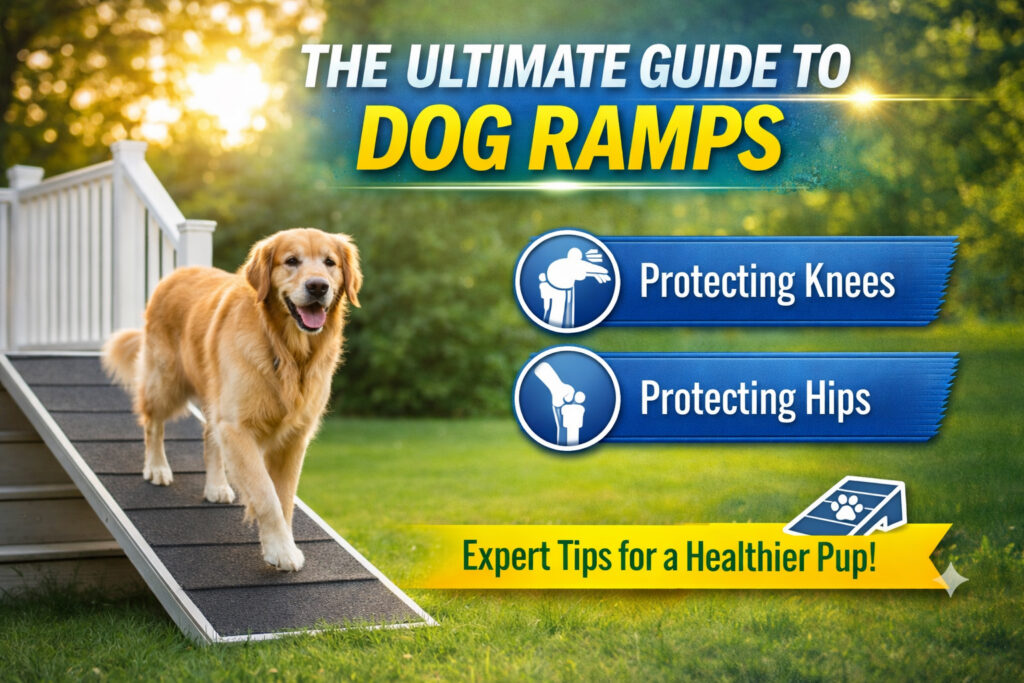
Think about the mechanics of a dog navigating stairs or leaping. Each jump or step involves:
For young, healthy dogs, their bodies are typically resilient enough to handle this. However, even in their prime, these actions create micro-traumas. As dogs age, or if they have pre-existing conditions, these activities become increasingly detrimental.
Breeds at Higher Risk:
Dog ramps offer a gradual incline, eliminating the harsh impact and twisting motions associated with jumping and stair climbing. This simple change provides a multitude of benefits:
Not all dog ramps are created equal. The “best” ramp depends on your dog’s size, your specific needs, and where it will be used.
Key Factors to Consider:
Types of Ramps for Different Needs:
Even the most perfect ramp is useless if your dog won’t use it! Here’s how to introduce it positively:
Investing in a high-quality dog ramp is an investment in your dog’s long-term health and happiness. By proactively protecting their joints from daily wear and tear, you can potentially:
Don’t wait until your dog is limping or showing signs of pain. Introduce ramps early as a preventative measure. Their knees and hips will thank you!
Ready to learn more about how to support your dog’s mobility? If you’re interested in a custom knee brace or need more personalized advice on choosing the right ramp, we’re here to help! Reach out to us via our contact form or send us a message on our Facebook page.
Traveling with your dog is usually full of excitement—new smells, new places, and shared adventures. But if your dog is recovering from ACL (cranial cruciate ligament) surgery or a knee injury, travel requires extra planning. Whether you’re heading out for a weekend visit with family or relocating across the country, preparation is the key to protecting your dog’s healing joint and preventing setbacks.
If your pup recently had surgery such as a TPLO (Tibial Plateau Leveling Osteotomy) or is recovering conservatively from a partial tear, this guide will walk you through exactly what to prepare before you hit the road (or the runway).
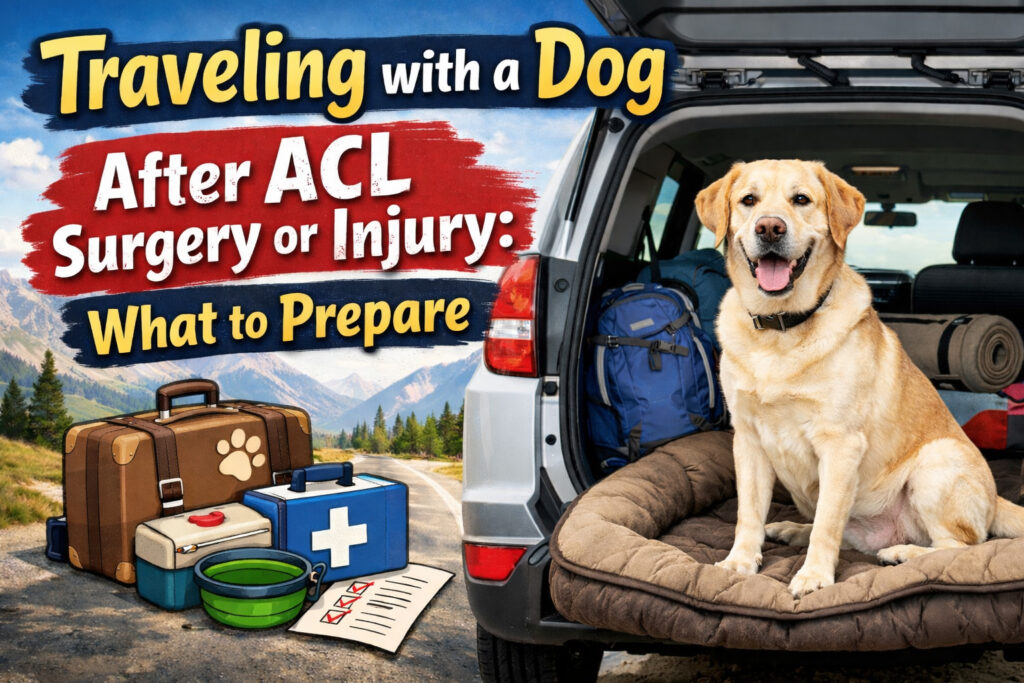
Before making any travel plans, speak with your veterinarian. Dogs recovering from ACL injuries are typically on a strict rehabilitation timeline. Traveling too soon—especially long car rides or flights—can increase inflammation, stiffness, and risk of reinjury.
Ask your vet:
For dogs that had procedures like TPLO, TTA (Tibial Tuberosity Advancement), or extracapsular repair, your vet may recommend waiting at least 6–8 weeks before non-essential travel.
If your dog is using a supportive brace for conservative management, confirm proper fit before leaving. A poorly fitted brace during extended activity can cause rubbing, swelling, or instability.
🚗 Car Travel
Car travel is typically the safest option for post-ACL dogs because you control rest stops and positioning.
Prepare:
Never allow your dog to roam freely in the car. Sudden stops can strain the healing leg.
✈️ Air Travel
Air travel adds complexity. Airlines often require dogs to remain crated for extended periods, which may not be ideal for recovery.
Check airline policies carefully. For example:
Each has different pet travel requirements. Some do not allow post-surgical animals without veterinary clearance documentation.
If flying is unavoidable:
Think of this as your dog’s mobility survival kit.
Essentials:
Optional but helpful:
Keeping everything organized in one bag ensures you’re not scrambling in unfamiliar locations.
Frequent, controlled breaks are critical during long car rides. Every 2–3 hours, stop for:
Avoid:
Keep walks short and structured. The goal is circulation—not exercise.
When choosing lodging, prioritize safety over aesthetics.
Look for:
If staying at a hotel, call ahead to confirm pet policies. Large hotel chains like:
are often dog-friendly—but policies vary by location. Bring your dog’s own bedding. Familiar scents reduce stress and encourage calm behavior, which supports healing.
One of the biggest risks while traveling is slick flooring—especially in hotels, vacation rentals, or family homes.
Tile, hardwood, and laminate floors can cause sudden slips that strain the healing ligament.
To prevent accidents:
If your dog uses a knee brace for stability, make sure it’s properly adjusted before indoor walking.
Travel disrupts routines—but recovery thrives on consistency.
Stick to:
Skipping rehab even for a few days can delay recovery. If your dog is mid-physical therapy, ask your rehab specialist for travel-friendly exercises you can perform in small spaces.
During and after travel, watch carefully for:
If you notice concerning changes, contact your veterinarian immediately. Early intervention can prevent a minor flare-up from becoming a serious reinjury.
It’s tempting to let your dog “enjoy the trip”—but recovery must remain the priority.
Avoid:
Instead, focus on:
Travel can be enriching without being physically demanding.
Research emergency veterinary clinics near your destination before leaving home. Save their phone numbers in your phone.
Websites like:
offer directories to help locate licensed veterinary facilities.
Bring:
If your dog has metal implants, having documentation readily available is helpful in case of emergency imaging needs.
Stress increases inflammation and slows healing. Travel is inherently stimulating, so keeping your dog calm is crucial.
Tips:
If your dog struggles with anxiety, discuss natural calming aids or temporary anti-anxiety medications with your veterinarian before travel.
Once you return home, give your dog 1–2 low-activity days to recover from travel strain.
Resume normal rehab gradually. Monitor for any stiffness or swelling that may have developed during the trip. Remember: Healing from ACL injury is a marathon, not a sprint. Travel should never compromise long-term joint stability.
Traveling with a dog after ACL surgery or injury isn’t impossible—but it does require thoughtful preparation. With veterinary approval, structured planning, and protective measures, you can safely include your recovering pup in your travel plans.
The keys are simple:
Your dog’s knee is healing every single day. Protecting that progress ensures they’ll return to the adventures you both love—stronger and more confident than ever.
If your dog is recovering from a CCL injury and needs additional joint support, make sure any mobility aids are properly fitted and approved by your veterinary professional before travel.
Safe travels—and steady steps forward.
Give your dog the support they deserve with our premium knee braces; get in touch today via our contact form or head over to our Facebook page.
When your dog tears their ACL (also called the CCL in dogs), it can feel like everything changes overnight. There’s the shock of diagnosis, the worry about surgery, the cost, the recovery timeline — and the hope that once it heals, life will go back to normal.
But here’s the truth many pet parents don’t hear soon enough:
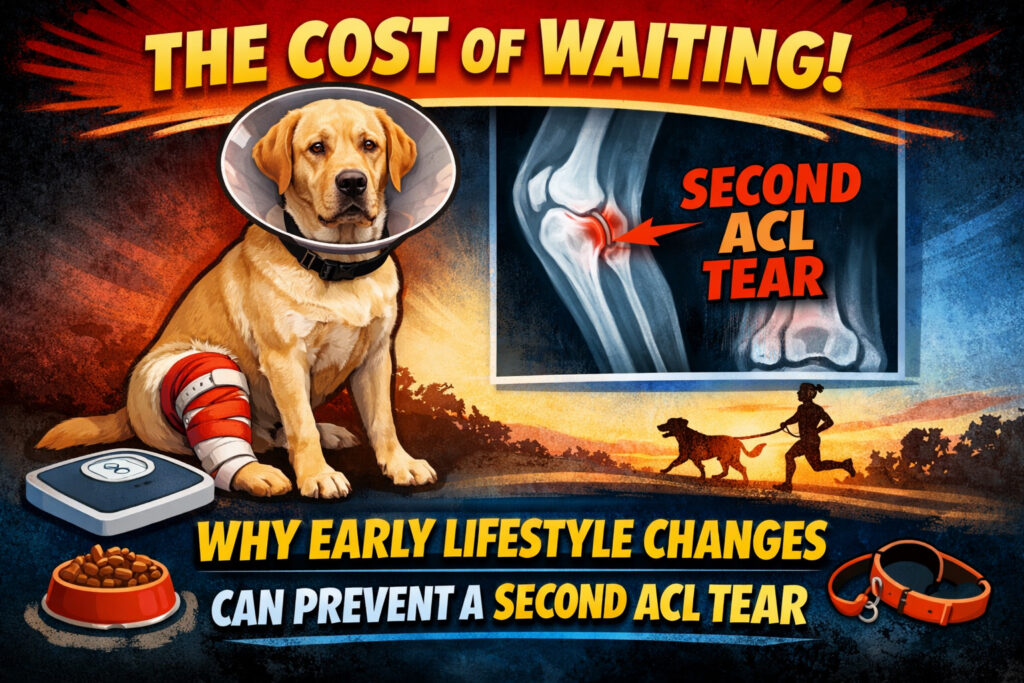
The biggest risk for a second ACL tear isn’t bad luck. It’s waiting too long to make the right changes.
If your dog has already torn one cruciate ligament, the other knee is now at significantly higher risk. Some studies suggest that more than 50% of dogs will tear the opposite ACL within 1–2 years. The good news? Early, proactive lifestyle changes can dramatically reduce that risk.
Let’s talk about the real cost of waiting — and what you can do today to protect your dog’s future mobility.
An ACL tear doesn’t just affect one knee. It changes how your dog moves.
After injury:
Even after surgery, subtle compensation patterns often remain. That means the “good” leg is doing more work than it should — sometimes for months.
Over time, that overload can lead to:
The clock doesn’t start ticking when your dog looks better. It starts the day the first injury happens.
Let’s be practical for a moment.
Surgical repair of a canine ACL tear (TPLO, TTA, or lateral suture) can cost anywhere from $3,000 to $7,000 per knee depending on location and surgeon. If both knees require surgery, that cost doubles.
Then there’s:
A second tear isn’t just another injury — it’s another recovery cycle, another confinement period, and another disruption to your dog’s quality of life.
Preventing that second injury isn’t just about money. It’s about avoiding putting your dog through it all again.
Here’s what happens when lifestyle changes are delayed:
1. Muscle Atrophy Gets Worse
After an ACL injury, the affected leg quickly loses muscle mass. If rebuilding strength is slow or inconsistent, the opposite leg absorbs extra load. That imbalance increases strain on the second knee.
2. Weight Gain Sneaks In
During recovery, activity drops. Calories often don’t.
Even a few extra pounds significantly increase pressure on the knees. For every pound of body weight, several pounds of force are transmitted through the joint during movement.
Extra weight = extra ligament stress.
3. Instability Becomes Habitual
If your dog continues jumping off furniture, racing on slippery floors, or pivoting hard during play, micro-damage can accumulate in the second ligament.
Ligaments don’t usually snap without warning. They weaken over time.
Waiting allows small issues to become major injuries.
The most powerful prevention tool is not reactive — it’s proactive. Here are the changes that matter most.
1. Optimize Weight Immediately
Even if your dog looks “fine,” ask your veterinarian to evaluate their body condition score.
A lean body:
A slight calorie adjustment today can prevent thousands of dollars in surgery later.
2. Modify High-Risk Movements
After the first ACL tear, your dog’s days of uncontrolled jumping and hard pivots should be over.
That means:
Install:
These changes are simple — but incredibly effective.
3. Rebuild Balanced Strength
The goal isn’t just healing the surgical leg. It’s building symmetrical strength.
Focus on:
Strong glutes and quadriceps reduce strain on both knees. Skipping this step is one of the biggest contributors to second tears.
4. Support the Joint During Vulnerable Phases
Even after healing, dogs can experience periods of fatigue, minor inflammation, or instability.
Supportive bracing during:
can help reduce strain on the opposite knee while strength builds evenly.
Support is not weakness. It’s strategic protection.
5. Keep Nails Trimmed and Paws Stable
Overgrown nails alter gait mechanics. That subtle shift changes knee alignment and increases ligament strain.
Likewise, dogs who frequently slip on smooth surfaces experience repeated micro-trauma to their joints.
Regular nail trims and traction control inside your home are small habits that make a big difference.
Dogs are masters at hiding discomfort.
By the time you see:
the ligament may already be partially torn.
Waiting for visible signs means you’re already behind. Early prevention happens before symptoms appear.
There’s also the heartbreak factor.
Another crate rest period.
Another round of restricted activity.
Another time saying “not today” to park trips.
Another surgery day.
Dogs thrive on movement and interaction. Multiple long recoveries can affect behavior, mood, and bonding.
Preventing a second tear protects more than knees — it protects your dog’s lifestyle.
Cruciate ligament disease in dogs is often degenerative, not purely traumatic.
That means:
When one ligament tears, it’s often because both were already compromised — one just failed first.
That’s why immediate protective changes are critical.
You’re not just guarding against an accident.
You’re managing an underlying condition.
If your dog has had one ACL tear, here’s your prevention checklist:
Think of it as a new chapter — not a temporary recovery phase.
Waiting costs:
Early lifestyle changes cost far less.
The difference between one ACL surgery and two often comes down to what happens in the months immediately after the first injury.
Your dog’s future mobility isn’t just determined in the operating room.
It’s shaped at home — on your floors, during your walks, in daily habits that either protect or strain that second knee.
The first tear may not have been preventable.
The second one often is.
Make the changes now — not after it happens again. For more information about our brace you can contact us via our contact form or visit us on Facebook.
Most dog owners think about slippery floors — but few think about flooring transitions. The small lip between tile and hardwood. The metal strip in a doorway. The raised threshold leading to a patio.
To us, they’re barely noticeable. To your dog’s knees, they can be a daily stress test.
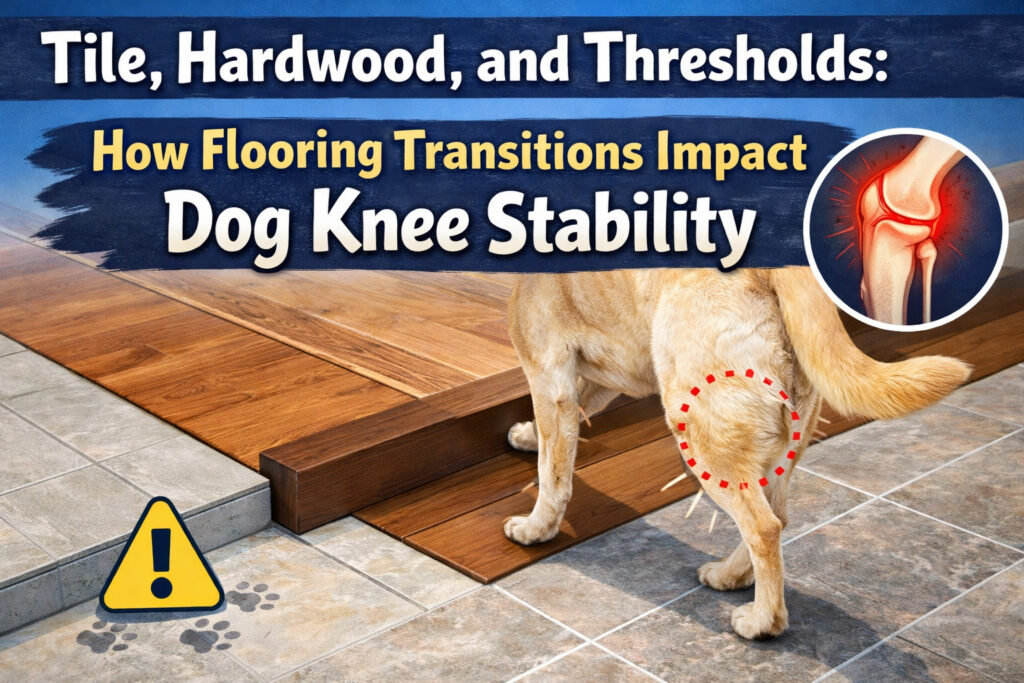
Dogs move fast. They don’t slow down to evaluate surface changes the way we do. When your dog runs from carpet to tile or hardwood to laminate, the sudden shift in traction can cause:
Over time, these repeated micro-adjustments can strain the CCL (ACL equivalent) — especially in active or larger dogs.
Raised door strips and uneven transitions are particularly risky because they:
For dogs healing from a previous CCL tear, these small obstacles can increase the chance of re-injury or strain on the opposite leg.
Take a walk through your house and look for these trouble spots:
You may notice your dog hesitates, shifts weight awkwardly, or slightly slides when crossing them.
You don’t need a renovation to protect your dog’s knees. Try:
Small adjustments can significantly reduce torque and instability in the knee joint.
Dog knee injuries are often the result of cumulative strain — not just dramatic accidents. Flooring transitions create subtle instability that can add up over time.
By identifying and correcting these hidden hazards, you’re not just improving traction — you’re protecting long-term joint health and giving your dog a safer environment to move confidently every day.
If you would like more information about our Posh Dog Knee Brace, please contact us through our contact form and be sure to visit us on Facebook to stay updated on tips, support, and new products for your dog’s joint health and recovery.
When your dog injures a knee, everything changes overnight.
The zoomies stop. The stairs become intimidating. Even getting up from a nap can look like hard work. Whether the diagnosis is a cruciate ligament injury, patellar instability, or post-surgical recovery, one thing becomes clear very quickly:
Healing a knee takes more than time.
Rehabilitation is where true recovery happens — not just rest, not just medication, but a structured plan that helps your dog rebuild strength, stability, and confidence.
Let’s walk through what that really looks like.
In the early days after a knee injury, rest is critical. The joint needs protection. Inflammation needs to calm down. Pain needs to be managed.
But prolonged inactivity has its own risks.
Muscles begin to weaken surprisingly fast. When the muscles surrounding the knee lose strength, the joint becomes even more unstable. That instability can slow healing — or worse, increase the risk of further damage.
Rehabilitation bridges the gap between “injured” and “functional.” It focuses on restoring:
Without a guided recovery plan, many dogs plateau. They may improve slightly but never regain full strength or stability.
A well-designed recovery program targets several key areas.
Early therapy helps reduce inflammation so your dog can move more comfortably. Less pain means better participation in exercises — and better participation means faster progress.
After injury or surgery, joints can stiffen. Gentle range-of-motion work keeps the knee flexible and prevents scar tissue from limiting mobility.
The knee doesn’t work alone. It relies heavily on surrounding muscles — especially the quadriceps and hamstrings. Strengthening these muscles provides natural support that reduces strain on healing tissues.
Dogs recovering from knee injuries often lose proprioception — the body’s sense of position and movement. That’s why they may seem wobbly or unsure on uneven surfaces. Targeted exercises help retrain coordination and reduce the likelihood of missteps.
A weak, unstable joint is vulnerable. Rehabilitation strengthens protective structures, helping safeguard both the injured leg and the opposite limb.
Every dog’s rehabilitation plan should be customized. However, most comprehensive programs include a combination of the following elements:
In the beginning, strict activity restriction is essential. That usually means:
As healing progresses, activity is increased gradually — not all at once. The goal is controlled, purposeful movement.
Rehabilitation exercises evolve over time.
Early Stage:
Mid Stage:
Advanced Stage:
Each phase builds on the previous one. Skipping ahead too quickly can undo weeks of progress.
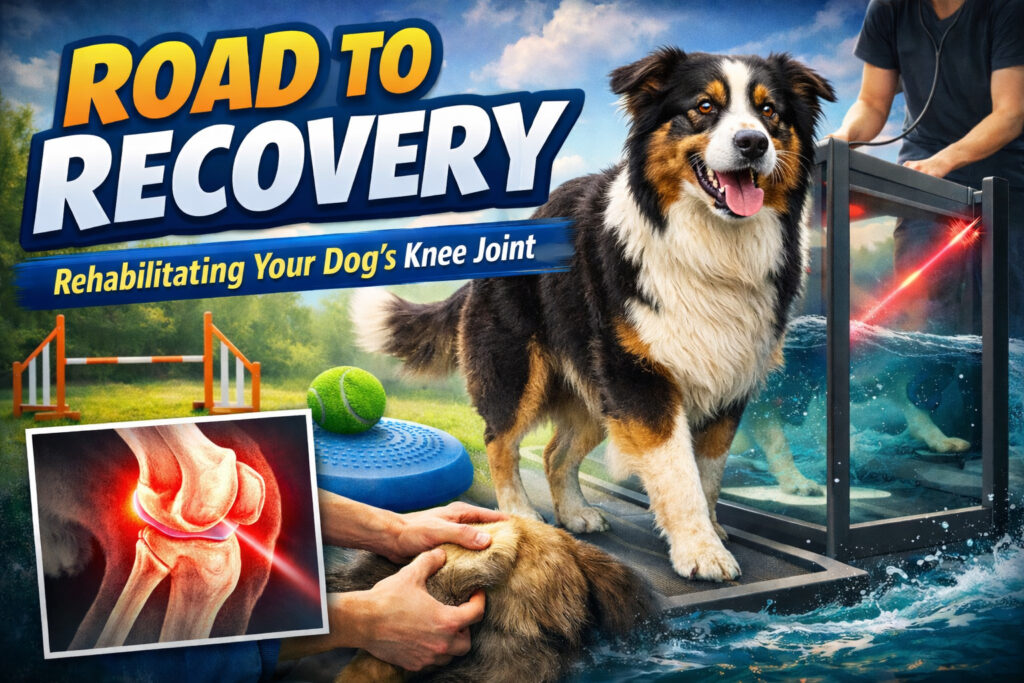
Hydrotherapy is a favorite in canine rehabilitation — and for good reason.
Water supports body weight, reducing impact on the knee while allowing muscles to work. Swimming or underwater treadmill sessions help build strength and improve range of motion without excessive strain.
For many dogs, it’s one of the safest ways to reintroduce exercise.
Hands-on techniques can make a noticeable difference. Massage helps:
Other therapies such as laser treatments may support tissue healing and inflammation control. Some dogs also respond well to acupuncture as part of a broader pain-management plan.
Clinic visits are important, but what happens at home matters just as much — if not more.
Your veterinarian or canine rehabilitation therapist will likely provide:
Consistency is everything. Small, steady improvements over time lead to meaningful recovery.
While some mild cases can be managed with basic at-home exercises, many dogs benefit greatly from working with a certified canine rehabilitation therapist.
These specialists assess:
They design customized programs based on your dog’s specific injury, surgical procedure (if applicable), age, and overall health.
Having expert oversight reduces guesswork and helps prevent common setbacks.
Rehabilitation typically moves through distinct stages:
The focus is minimizing inflammation and protecting the joint. Activity is extremely limited.
Light exercises are introduced to maintain mobility and prevent stiffness.
Muscle rebuilding becomes the priority. Balance and coordination work increase.
Activity levels slowly expand. Controlled play may resume under supervision. Each phase requires patience. Rushing the timeline often leads to reinjury.
Knee rehabilitation isn’t just physical — it’s mental.
Active dogs can become frustrated during restricted activity. You may notice:
Providing enrichment through puzzle toys, calm training sessions, or scent games can help keep their mind engaged while their body heals.
Your attitude also matters. Dogs read our energy. Staying calm, consistent, and encouraging can help them stay motivated.
Rehabilitation doesn’t deliver overnight results. It unfolds in small milestones:
Progress may feel slow at times, but steady consistency almost always wins.
Skipping exercises or returning to full activity too early can set recovery back weeks. Trust the process.
A knee injury can feel overwhelming in the beginning. But with a structured rehabilitation plan, many dogs regain excellent function and return to happy, active lives.
The key ingredients are:
Healing a knee isn’t about simply waiting — it’s about actively rebuilding strength, stability, and confidence step by step.
And when you finally see your dog moving comfortably again, you’ll know every careful, steady day of rehabilitation was worth it. For more information about our brace you can contact us via or contact form or visit us on our Facebook.
When a dog suffers from a knee injury—especially issues like a torn ACL (cranial cruciate ligament)—finding the right support solution becomes critical. In recent years, 3D-printed dog knee braces have gained attention for their modern appeal and promise of customization. At first glance, they seem like a smart, high-tech solution. But when you look closer at how they function in real-world use, serious concerns start to emerge.
The truth is, not all “custom” solutions are created equal. In fact, 3D-printed dog knee braces often fall short in the areas that matter most: comfort, safety, and adaptability. Let’s break down why these braces can be problematic—and why a thoughtfully designed alternative like Posh Dog Knee Braces offers a more reliable and dog-friendly solution.
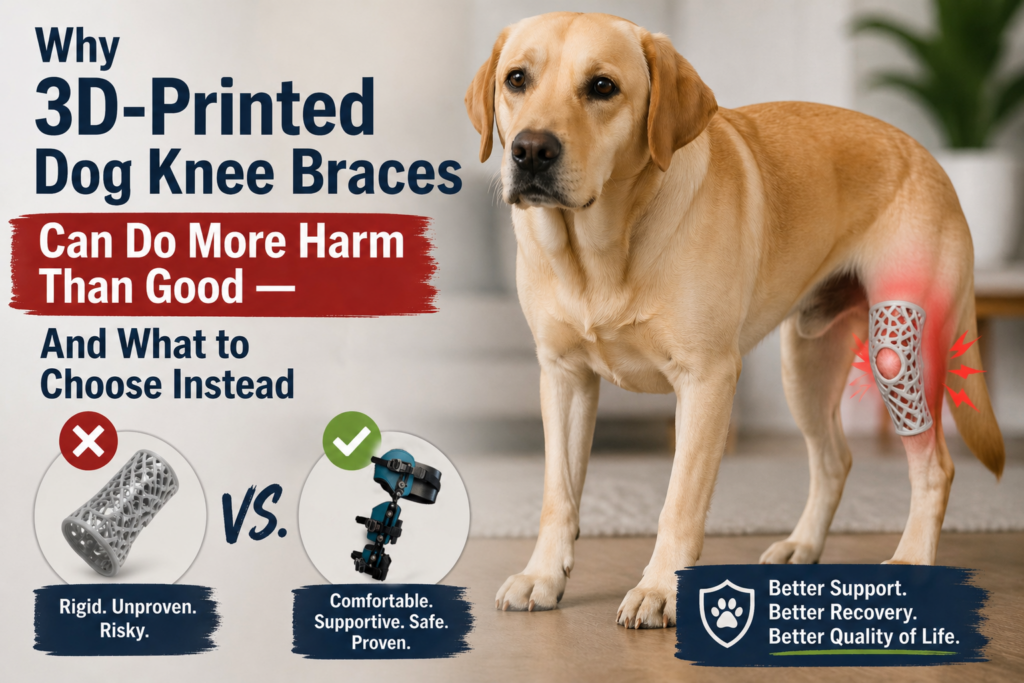
3D-printed braces are typically made from hard plastics or composite materials. While these materials allow for structural precision, they come with a major downside: rigidity.
Dogs are not static creatures. They run, jump, twist, sit, and lie down in ways that require flexibility from anything attached to their bodies. A rigid brace does not accommodate natural movement—it resists it. This can lead to:
Instead of supporting healing, a stiff brace can actually interfere with it by forcing the dog into unnatural movement patterns.
Even with smoothing processes, 3D-printed braces can have hard edges or pressure zones that don’t adapt well to a dog’s anatomy. Unlike humans, dogs can’t communicate discomfort clearly—they show it through behavior. By the time you notice limping, licking, or refusal to wear the brace, irritation may already be significant.
Common issues include:
Because these braces are rigid, they don’t “give” when pressure builds. That means small fitting imperfections can quickly turn into painful problems.
Even if a 3D-printed brace is initially based on a scan or measurements, it represents a fixed shape at a single point in time.
But dogs’ bodies change:
A rigid brace cannot adapt to these changes. What fit “perfectly” on day one may become too tight, too loose, or uneven within weeks.
Most 3D-printed braces lack meaningful adjustability. Once produced, their structure is set. While some may include straps, the core support system remains inflexible.
This creates a problem for long-term use. If adjustments are needed, you’re often looking at replacing the entire brace—costing more time, money, and stress for both you and your dog.
This is where Posh Dog Knee Braces stand apart.
Rather than relying on rigid materials, these braces are designed with flexibility, comfort, and real-world wearability in mind. They’re built not just to “fit,” but to function alongside your dog’s natural movement.
Instead of hard plastic shells, Posh Dog Knee Braces use durable yet flexible materials that provide support without restriction. This allows:
Your dog can walk, sit, and rest without fighting against the brace.
A key advantage is the smooth, padded construction. Every point of contact is designed to minimize irritation.
That means:
This dramatically reduces the risk of sores, chafing, and discomfort—especially for dogs who need to wear a brace daily.
Posh Dog Knee Braces focus on true customization, not just a one-time mold or scan. Their design accounts for the reality that dogs change during recovery.
With adjustable components, the brace can evolve with your dog’s needs—whether that means accommodating swelling, improving muscle tone, or fine-tuning support levels.
A good knee brace isn’t just about immediate injury—it’s about ongoing joint health.
Posh Dog Knee Braces are designed for durability and adaptability, making them suitable for:
Instead of replacing the brace as conditions change, you can adjust and continue using it effectively.
One of the most overlooked factors in canine recovery is whether the dog will actually wear the brace.
Dogs resist discomfort. If a brace pinches, rubs, or restricts them, they’ll fight it—making recovery harder.
Because Posh Dog Knee Braces prioritize comfort, dogs are far more likely to:
And consistency is key to healing.
3D-printed dog knee braces may look innovative, but their rigid structure, potential for sharp pressure points, and lack of adaptability make them a risky choice for many dogs.
When it comes to something as important as your dog’s mobility and comfort, design matters more than novelty.
A brace should work with your dog—not against them.
Posh Dog Knee Braces offer a smarter, more compassionate approach: one that prioritizes flexibility, comfort, and true customization. By choosing a brace designed around your dog’s real-life movement and needs, you’re not just supporting recovery—you’re improving their quality of life. For more information you can contact us via our contact form check us out on Facebook.
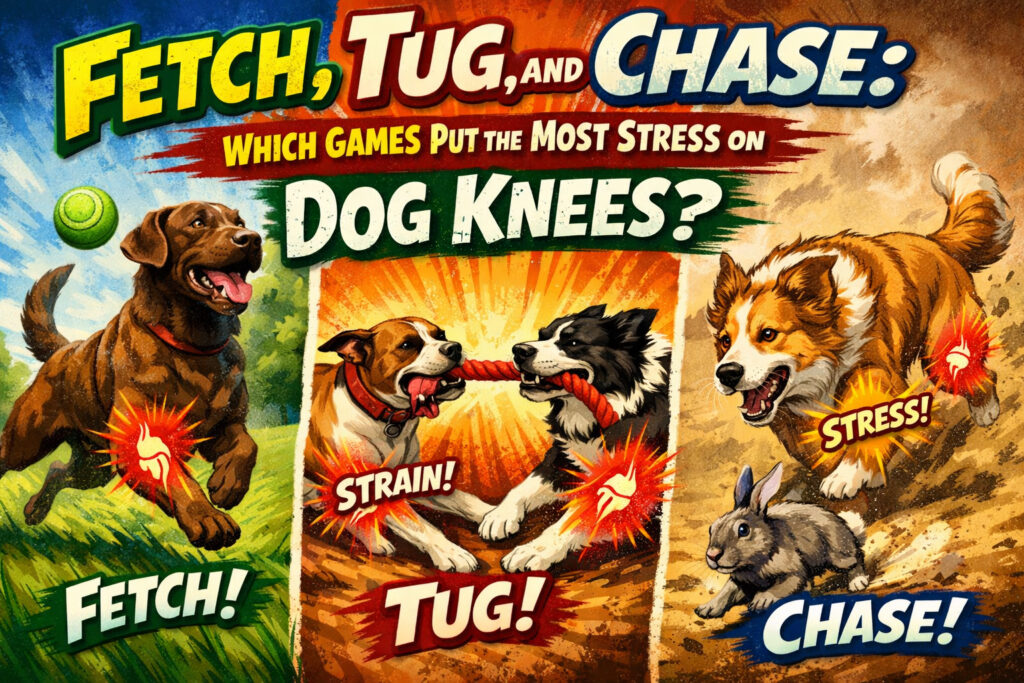
Play is one of the great joys of dog ownership — it builds bond, burns energy, and keeps pups mentally sharp. But some games put more mechanical load on a dog’s stifle (knee) than others, and repeated awkward landings, sudden turns, or sustained strain can increase the chance of injuries such as cranial cruciate ligament (CCL) rupture. Below I break down the three most common play styles — fetch, tug, and chase — explain how each stresses the knee, point to what the research and vets say, and give practical ways to keep play fun and safe.
Large-scale veterinary reviews and studies show that CCL rupture is common and multi-factorial — genetics, body weight, age, and activity type all matter. Fitness and core strength help lower risk, while high-intensity competitive sports (e.g., flyball, some obstacle work) are associated with more stifle injuries.
Fetch often looks harmless, but the main risk to knees comes from jumping and landing. A dog sprinting at full speed, leaping for a ball or frisbee, and then coming down on hard or uneven ground experiences sudden peak vertical forces through hips and stifles. Awkward rotations on landing (if the dog twists to chase or the surface is slippery) are what commonly strain ligaments. Veterinary guidance warns that long, repetitive sessions — or throwing high, erratic throws that force big leaps during fetch — increase the chance of acute or cumulative injury.
How to make fetch safer
Tug-of-war feels intense, but biomechanically it’s different: it’s mostly a pulling-and-holding game, not one full of high jumps or sudden multi-directional turns. That means knees typically take less violent impact compared with fetch or chase. Still, tug has its hazards: sudden lunges, jerking motions, or dogs bracing with legs splayed can put strain on shoulders, necks, and sometimes the stifle — especially if play is rough or if the dog is already injured. Experts recommend playing tug with rules (start/stop cues) and appropriate toys, and avoiding rope toys that fray and can become dangerous if ingested.
How to make tug safer
Chase games (especially those that simulate prey — e.g., someone dashing away while the dog zig-zags after them) can be deceptively risky. The dangerous element isn’t just speed but rapid decelerations and sharp pivots. When a dog makes a high-speed pursuit then suddenly turns or plants to change direction, torsional forces go through the knee — and repeated or extreme pivots are strongly linked to stifle injuries in athletic dogs. Studies of agility and working dogs show that quick turns, landings, and repetitive high-load maneuvers are associated with higher stifle injury rates.
How to make chase safer
If we rank purely on knee stress potential:
That said, risk is contextual. A two-hour unsupervised ball-throwing session on a rock-hard surface can be worse than a five-minute supervised frisbee toss on soft turf. Similarly, a young, unconditioned working-breed sprinting through tight turns is more vulnerable than a fit, adult dog doing the same.
Certain dogs are more likely to suffer stifle injuries: large and giant breeds, overweight dogs, dogs with certain conformational or genetic predispositions, and dogs that are under-conditioned (poor core strength). Conversely, dogs with good conditioning, balanced body weight, and controlled play tend to fare better. A veterinary review and related research emphasize that fitness and core strength reduce ligament tear odds, while some high-intensity sports elevate risk.
If your dog limps, is reluctant to bear weight, shows swelling around the knee, or has sudden changes in activity level after play — pause all strenuous activity and consult your veterinarian. Early evaluation can spot ligament strains before they become full ruptures.
No single game is “always safe” or “always dangerous.” The difference lies in intensity, surface, frequency, the dog’s body, and how you manage play. Chase and repetitive, high-impact fetch jumps carry the most potential to stress a dog’s knees, while tug is typically lower-impact for stifles if played sensibly. Use controlled play, conditioning, and common-sense safeguards to keep the zoomies joyful — and knees intact. For breed- or dog-specific advice, ask your veterinarian; they can assess risk factors and recommend conditioning or alternative activities tailored to your pup.
For more information on how the Posh Brace can support your dog’s recovery and joint health, feel free to reach out via our contact form or visit our Facebook page to see it in action.
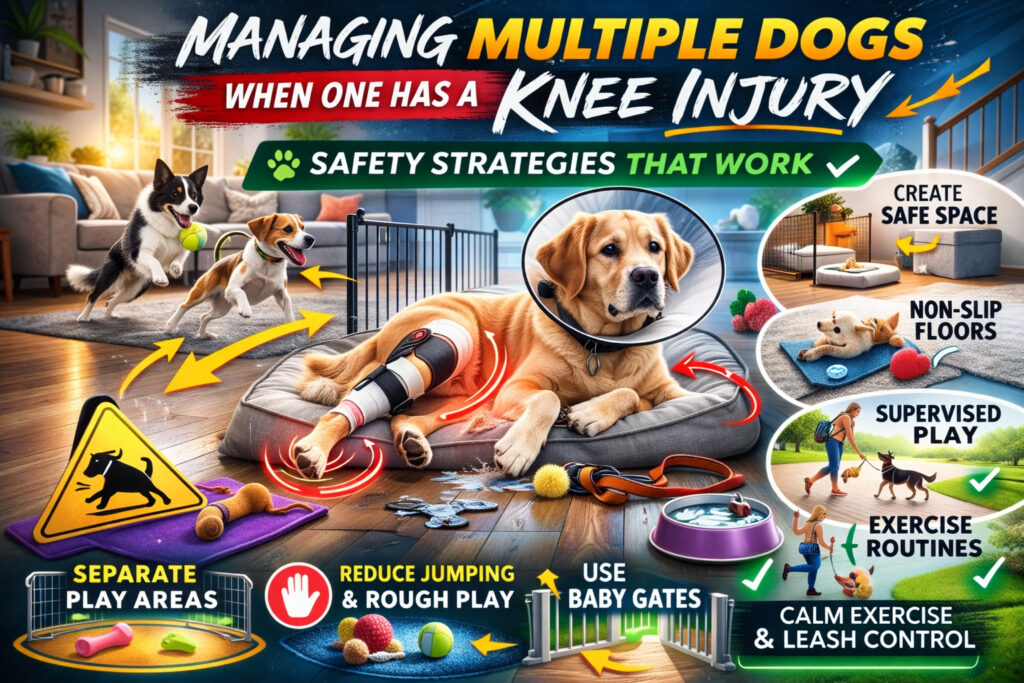
When you have more than one dog, life is usually full of movement—shared zoomies, backyard wrestling matches, synchronized barking at the mail carrier, and group excitement at the sound of car keys. But when one dog suffers a knee injury, everything changes.
Whether your dog has experienced a cranial cruciate ligament (CCL) tear (often referred to as an ACL injury), had surgery, or is being managed conservatively, your entire household routine needs adjustment. The challenge isn’t just protecting the injured knee—it’s managing energy, space, and interactions so healing can happen safely. If you’re navigating multi-dog life during recovery, here’s how to keep everyone safe and sane.
Dogs don’t operate on “light duty” naturally. They communicate and play physically. Even calm dogs can bump, chase, or initiate play without warning.
After common surgical repairs or bracing:
…controlled movement is essential for proper healing.
Unplanned wrestling or sudden chasing can:
In multi-dog households, prevention requires structure—not just hope.
You don’t necessarily need to isolate your injured dog 24/7—but you must manage high-energy moments.
Common trigger times include:
During these times, use:
Prevention is always easier than correcting excitement once it starts.
It may feel excessive, but short-term indoor leash management can be extremely effective.
Keep your recovering dog on a lightweight leash indoors so you can:
If other dogs are excitable, leash them too during shared time. Calm coexistence is the goal—not total separation, but structured interaction.
Even gentle play can escalate quickly.
During knee recovery:
It only takes one pivot or collision to undo weeks of healing.
Instead, provide:
Remember: Physical rest doesn’t mean emotional isolation.
If you have a fenced yard, don’t assume it’s safe for unsupervised group turnout.
Options that work:
Backyard sprints are one of the biggest causes of reinjury. If your other dogs are high-drive breeds, this becomes even more important. Excitement spreads quickly in a group.
Food increases competition and energy.
Best practices:
Guarding behaviors—even mild ones—can trigger sudden lunging.
You want predictability and calm during recovery.
Your injured dog needs a designated safe space.
This area should:
A crate or exercise pen provides structure and safety—especially in early post-op weeks.
The recovery zone isn’t punishment. It’s protection.
Here’s something many owners don’t realize:
Dogs who tear one CCL often injure the other within 1–2 years. Using a Posh Dog Knee Brace can significantly decrease this risk, sometimes by 70%.
In multi-dog households, overcompensation risk increases because:
Protecting the healing leg also protects the opposite knee. Controlled, symmetrical movement is essential.
One common mistake? Letting the entire household energy drop drastically.
Your healthy dogs still need:
If they don’t get it, they’ll redirect that energy toward the recovering dog.
Schedule:
A tired dog is a calm dog—and calm dogs protect healing knees.
Multi-dog households tend to erupt when someone enters the home.
To manage this:
Excited pack greetings can involve jumping, circling, and bumping—all dangerous during recovery.
Calm entrances set the tone.
Recovery is a great time to reinforce impulse control.
Teach:
Structured training strengthens communication and lowers chaos.
Dogs thrive on clarity.
Watch for:
Intervene early.
Don’t wait for escalation.
If you see play energy building, separate before it turns physical.
Until your veterinarian clears full activity, assume that unsupervised time is unsafe.
Even bonded dogs can:
Short-term vigilance prevents long-term setbacks.
When your veterinarian confirms healing progress, don’t immediately return to full-speed play.
Instead:
Muscle strength takes time to rebuild—even after surgical repair.
Healing bone does not equal fully conditioned muscle.
It’s easy to feel guilty separating dogs or limiting activity.
But remember:
You are preventing reinjury.
You are protecting thousands of dollars in surgery.
You are avoiding prolonged pain.
Recovery is temporary. Chronic instability is not.
Dogs sense stress in the household.
Maintain:
Your injured dog needs emotional stability as much as physical rest.
Isolation without interaction can increase anxiety, which leads to restless behavior.
Balance is key.
Managing multiple dogs when one has a knee injury isn’t about isolating the injured dog from the family—it’s about controlling variables during healing.
Success comes from:
Recovery from a CCL injury isn’t just medical—it’s environmental.
Your home becomes part of the treatment plan.
With intentional management, your injured dog can heal properly without creating chaos in the rest of your pack.
And when recovery is complete, your structured leadership may even leave your household calmer and more balanced than before. For more information about our Posh brace you can contact us via our contact form or visit us on Facebook.
When comparing the Posh Dog Knee Brace to other dog knee braces, it stands out as an affordable custom option that offers better fit and stability than off-the-shelf braces, while costing less than many premium custom competitors. It’s a strong choice for dogs with ACL (CCL) injuries needing reliable, non-surgical support.
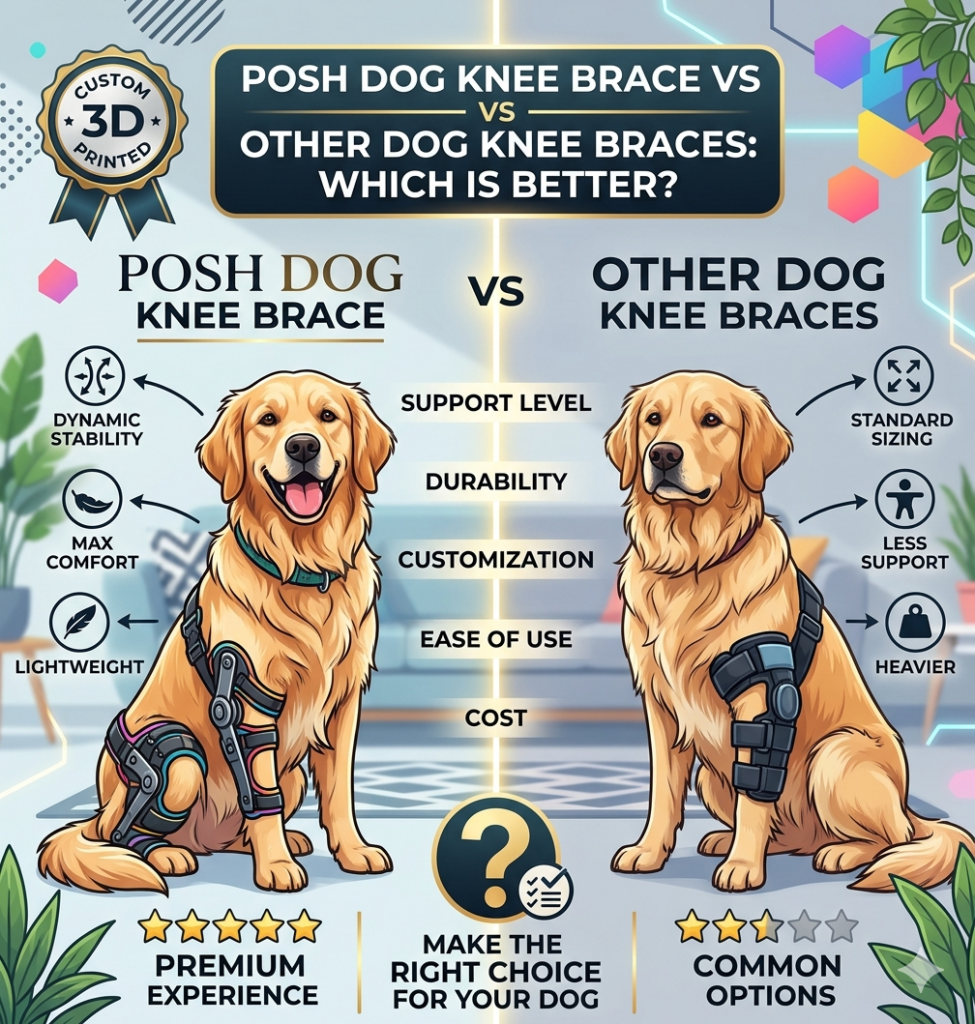
When choosing a dog knee brace, most owners are deciding between:
| Feature | Posh Dog Knee Brace | Premium Custom Braces | Off-the-Shelf Braces |
|---|---|---|---|
| Fit | Custom | Custom | Standard sizing |
| Support Level | Very High | High | Moderate |
| Comfort | Very High | High | Low |
| Price | Mid-range | High | Low |
| Availability | Custom order | Custom order | Immediate purchase |
Premium braces may offer:
But they also come with:
👉 For many dog owners, the extra cost doesn’t always translate into significantly better everyday results.
Off-the-shelf braces:
However:
👉 This makes them better for mild cases, but not ideal for moderate to severe ACL injuries.
👉 Compared to surgery ($2,000–$5,000+), all brace options are significantly more affordable.
When comparing dog knee braces, the Posh Dog Knee Brace stands out as a smart middle-ground option—offering the benefits of a custom brace without the high cost of premium competitors.
For many dog owners, it delivers the best balance of affordability, support, and real-world results, making it one of the most practical choices for managing ACL injuries without surgery. To purchase a Posh Brace please visit our product page and if you would like to see customer reviews visit our Facebook.
Yes, because it is custom-fit, it provides better stability, comfort, and effectiveness.
It offers similar core benefits but at a more affordable price point, making it a strong value choice.
Custom braces generally work best, especially for moderate to severe injuries.
In many cases, yes—especially for older dogs or less severe injuries.