Post Published on July 27, 2026
If your dog explodes through the front door like they’ve just been released from a starting gate, you’re not alone.
Doorway launches — that full-speed burst from a standstill — are one of the most overlooked risk factors for knee injuries in dogs.
It looks harmless.
It feels normal.
But biomechanically? It’s one of the highest-stress movements your dog performs.
Let’s break down why.
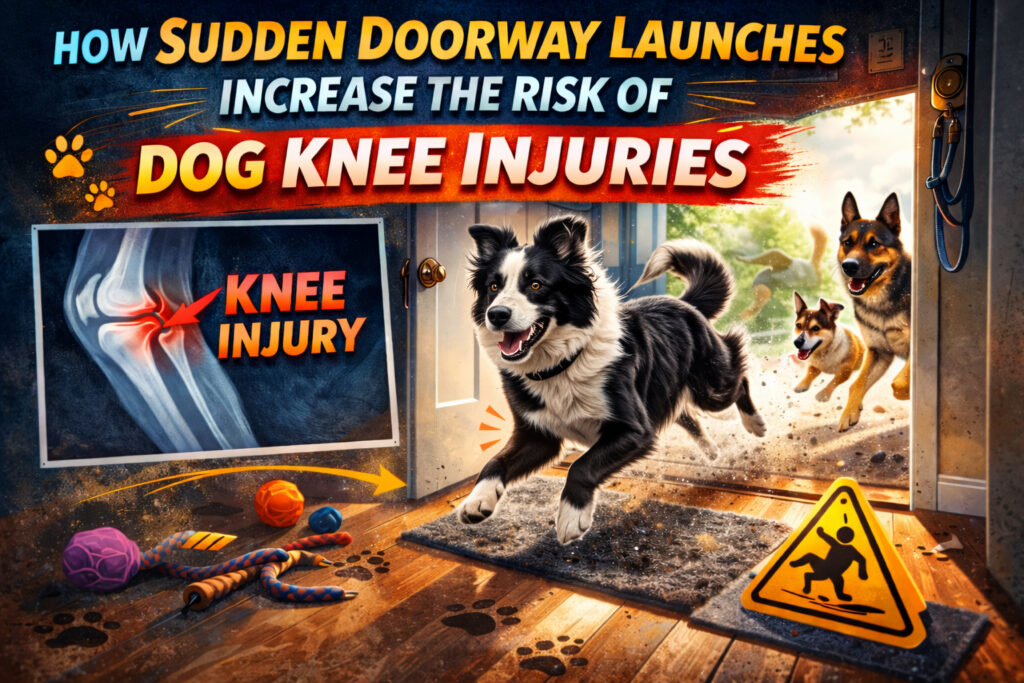
When your dog bolts through a doorway, several things happen at once:
This creates torsion + forward thrust + impact load — the exact combination that stresses the cranial cruciate ligament (CCL), commonly called the ACL in dogs.
The cranial cruciate ligament (CCL) stabilizes your dog’s knee joint and prevents the tibia from sliding forward.
Unlike humans, dogs rarely tear this ligament from a single dramatic event. Most tears are degenerative, meaning the ligament weakens over time.
A sudden doorway launch can be the moment that weakened ligament finally ruptures.
1. Hard, Slippery Surfaces
Entryways are often tile, hardwood, or sealed concrete — all low-traction surfaces.
If the rear foot slips even slightly during push-off, torque increases dramatically at the knee.
2. Sharp Direction Changes
Many dogs don’t run straight out the door. They:
That quick pivot multiplies strain on the CCL.
3. Explosive Push-Off
From a biomechanical standpoint, launching from a stationary stance generates more force than steady acceleration.
It’s similar to a human basketball player jumping into a sprint from a dead stop.
While any dog can experience a knee injury, higher-risk groups include:
Structure, genetics, and body weight all play a role.
Before a full tear occurs, you may notice:
These signs often appear weeks or months before a full rupture.
Here’s what many dog owners don’t realize:
After one CCL tear, the opposite knee has a significant chance of tearing within 1–2 years.
Why?
Because your dog shifts weight to compensate, increasing stress on the “good” leg — especially during high-impact movements like doorway launches.
You don’t have to eliminate excitement — just manage it strategically.
🐾 1. Train a “Wait” Command at the Door
Teaching impulse control reduces explosive launches and protects joints.
🐾 2. Improve Traction
Add:
Better grip = less torque on the knee.
🐾 3. Maintain Ideal Weight
Extra pounds dramatically increase joint stress during acceleration.
🐾 4. Build Controlled Muscle Strength
Strong quadriceps and hamstrings help stabilize the knee and absorb force.
🐾 5. Consider Preventative Support
If your dog shows early instability or has already injured one knee, proactive support can help protect the joint during high-risk movements.
Seek veterinary evaluation if your dog:
Early diagnosis can reduce long-term arthritis progression and joint damage.
Sudden doorway launches may seem harmless, but they combine:
For a healthy ligament, that may not be a problem.
For a weakened one, it can be the tipping point.
The goal isn’t to eliminate your dog’s excitement. It’s to channel it safely.
A few small adjustments at the doorway can protect your dog’s knees — and help keep those joyful sprints injury-free for years to come. 🐾
For more information about our Posh Dog Knee Brace you can contact us via our contact form or visit us on Facebook.
Articles from the Posh Dog Knee Brace team — a group effort with our licensed veterinary technicians and brace specialists, sharing 15+ years of experience helping dogs recover from CCL/ACL injuries and mobility challenges.