Post Published on August 31, 2026
When most dog owners think about ACL injuries, they picture a dramatic event—a dog sprinting across the yard, making a sharp turn at the dog park, jumping off the couch, or landing awkwardly after a game of fetch.
But sometimes, the problem isn’t happening at the park.
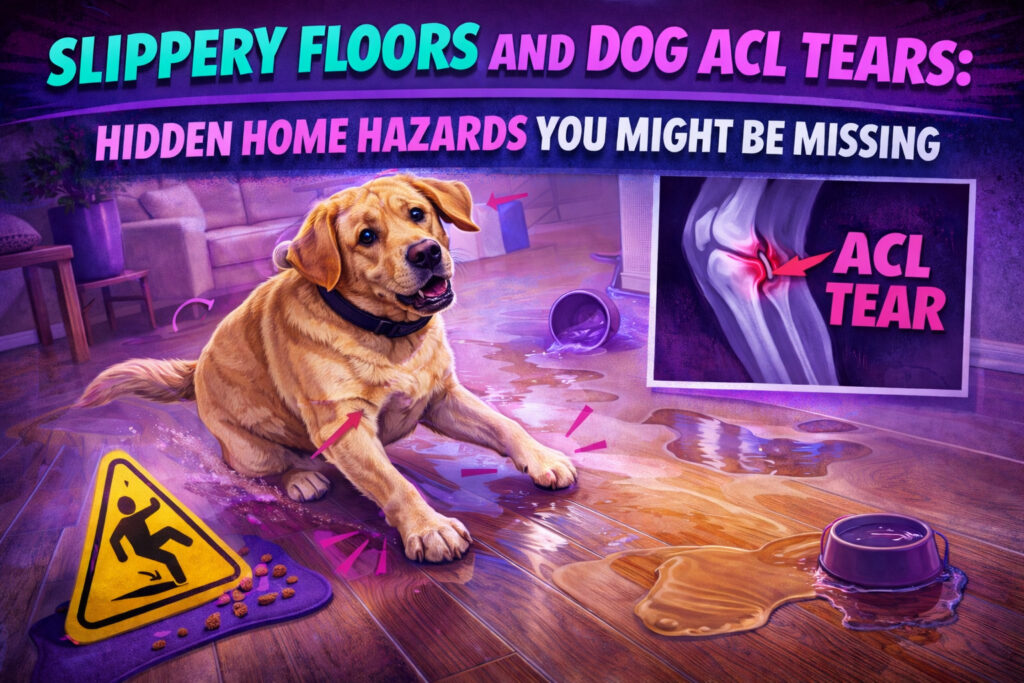
Hardwood, tile, laminate, vinyl, polished concrete, and other smooth flooring surfaces can create a surprisingly difficult environment for dogs to navigate. What feels perfectly normal to us can be challenging for a dog whose paws are constantly trying to find enough traction to keep the body stable.
A single slip doesn’t necessarily mean a dog will tear a CCL. However, repeated slipping, sliding, sudden twisting, and compensatory movements can place additional stress on the muscles, tendons, and ligaments supporting the knee.
For dogs that are already predisposed to CCL problems—or dogs recovering from a previous injury—traction becomes even more important.
The good news?
You don’t necessarily need to replace your floors.
A few simple changes throughout your home can make your dog’s environment safer and more comfortable.
Dogs depend heavily on traction to control their movements.
When a dog walks or runs across a surface with good grip, the paws can push against the ground while the muscles and joints work together to control the body’s movement.
On a slippery surface, that relationship changes.
Instead of the paw staying firmly planted, it may slide forward, backward, or sideways. When that happens, the dog’s body has to react quickly to prevent a fall.
The result can be:
These movements don’t automatically cause a CCL tear, but they can create situations where the knee experiences forces it wasn’t expecting.
And the problem isn’t necessarily one dramatic slip.
It can be the repetition.
A dog that slides several times every day while getting off the couch, running through the hallway, turning around in the kitchen, or racing toward the front door may repeatedly place stress on its joints.
Over time, those small challenges can become part of the bigger picture of joint health.
The structure commonly called the dog’s ACL is more accurately known as the cranial cruciate ligament (CCL).
The CCL is one of the major stabilizing ligaments inside the dog’s knee, or stifle joint. It helps control forward and rotational movement between the bones of the knee.
When the CCL becomes damaged or ruptures, the knee can become unstable.
A CCL injury can lead to:
Some dogs experience a sudden traumatic rupture, while others develop CCL disease gradually as the ligament weakens over time.
That means prevention isn’t always about avoiding one specific accident.
It’s also about reducing unnecessary stress on the knee whenever possible.
Humans generally have shoes or bare feet with relatively broad contact against the floor.
Dogs are different.
Their paws are smaller points of contact, and their ability to grip a surface depends on the texture of their paw pads, nail length, body position, speed, and the flooring itself.
A healthy dog may compensate easily for an occasional slip.
But consider a dog that is:
That dog may have considerably less room for error.
A slippery floor can turn an ordinary activity—such as standing up and walking across the room—into a balance and stability challenge.
You may already have rugs in your living room and still have several slippery areas that your dog uses every day.
The biggest problems are often found in transition areas and high-excitement zones.
Think about what happens when someone comes home.
Your dog hears the door.
Excitement kicks in.
The dog runs toward the entrance, turns sharply, and may attempt to stop suddenly on a smooth surface.
That combination of speed + excitement + low traction can create an unstable situation.
Consider placing a non-slip runner or mat between the door and the area where your dog typically waits.
Hallways are often overlooked.
They’re long, narrow spaces where dogs naturally pick up speed.
A dog running down a hardwood hallway may suddenly need to turn into another room. If the paws can’t grip the floor, the rear legs can slide while the dog’s body continues moving forward.
A properly secured runner can provide traction along the entire path.
Make sure the rug itself doesn’t slide. A loose rug can create a different hazard.
The kitchen can be a particularly active area for dogs.
Food smells, feeding routines, family activity, and excitement can all encourage a dog to move quickly.
Smooth kitchen flooring can become even more slippery when there is:
A washable, non-slip mat near food and water bowls can help provide a more stable standing surface.
This area deserves special attention.
Dogs frequently shift their weight while eating and drinking. If the bowl slides across the floor or the dog’s paws move while they’re standing, the dog may repeatedly adjust its stance.
Consider using:
The goal is simple:
Keep your dog’s paws underneath them instead of allowing them to slide around.
Stairs already require coordination, balance, and controlled movement.
The landing at the top or bottom can be particularly problematic if the flooring changes from carpet to hardwood, tile, or another slick material.
A dog coming down stairs may have forward momentum and need to stop quickly. Good traction on these transition points can provide an important extra layer of stability.
Jumping isn’t the only concern.
Think about what happens when your dog jumps off furniture.
They land, their weight shifts forward, and they immediately need to stabilize themselves.
If the landing surface is slippery, the paws can slide when the dog hits the floor. For dogs already experiencing knee problems, consider limiting furniture jumping and providing a stable landing area with a non-slip rug or mat.
Exterior doors are another common excitement zone.
A delivery driver arrives.
Someone rings the doorbell.
A family member comes home.
Your dog suddenly goes from lying quietly to sprinting across the house.
That explosive acceleration can be harder on the knees when the floor provides little traction.
A runner or mat along the path your dog usually takes toward the door can help reduce sliding.
Every dog owner knows the zoomies.
One moment your dog is relaxing.
The next moment they’re racing around the house at full speed.
Zoomies aren’t inherently bad. Dogs need opportunities to exercise and play.
The concern comes when high-speed movement meets poor traction.
A dog running on a slippery surface may have difficulty stopping or changing direction.
Instead of slowing down gradually, the dog may:
That sequence can create significant forces through the limbs.
This is one reason providing better traction in the areas where your dog gets the zoomies can be especially valuable.
If your dog has already experienced a CCL injury, flooring deserves even more consideration.
After an injury, dogs often change the way they move.
They may shift more weight onto the opposite leg, shorten their stride, avoid certain movements, or develop compensatory movement patterns.
If the injured leg is painful or unstable, the dog may rely more heavily on the other limb.
That creates an important concern:
The opposite knee may already be working harder than normal.
Adding slippery flooring to the equation can make maintaining balance and controlling movement even more difficult.
This is why traction should be considered part of the overall home environment during recovery—not just something to think about after a slip occurs.
Always follow your veterinarian’s rehabilitation and activity recommendations following an injury or surgery.
The good news is that improving traction usually doesn’t require an expensive home renovation.
Small changes can make a meaningful difference.
Place runners along the routes your dog uses most often.
Good locations may include:
Choose rugs with a secure non-slip backing or use an appropriate rug pad.
A rug that moves underneath your dog isn’t providing the protection you’re looking for.
A sturdy non-slip mat near the front and back doors can help create a traction zone where your dog is most likely to accelerate or stop.
This can be especially useful if your dog becomes excited whenever someone enters or leaves the house.
Water spills can turn an already smooth floor into an extremely slippery one.
Use a mat beneath the bowl and clean up spills promptly.
Long nails can affect how a dog positions its paws and interacts with the floor.
Regular nail maintenance can help your dog maintain better contact with the surface.
If you’re uncomfortable trimming your dog’s nails yourself, ask your veterinarian, groomer, or veterinary professional for assistance.
For dogs with furry feet, excessive hair between the paw pads can sometimes interfere with traction.
Keeping the hair around the paw pads appropriately maintained may help improve contact with the floor. Ask your groomer or veterinary professional about the best approach for your dog’s coat type.
Sometimes the floor isn’t naturally slippery—the cleaning products are the problem.
Certain cleaners can leave behind a residue that makes hard flooring even slicker.
Follow the manufacturer’s cleaning instructions for your flooring and make sure the surface is fully dry before allowing your dog to race across it.
There are paw waxes, grip products, socks, boots, and other products marketed to help dogs navigate slippery surfaces.
Some dogs tolerate these products well, while others don’t.
If you use a traction product, make sure it fits properly and doesn’t interfere with your dog’s natural movement.
Never assume a product is appropriate simply because it is marketed for dogs with mobility problems. If your dog has a known orthopedic condition, ask your veterinarian or rehabilitation professional whether a particular product makes sense for your situation.
Floor traction is only one piece of the puzzle.
A dog’s overall orthopedic health also depends on factors such as:
Maintaining a healthy body condition can reduce the amount of load placed on the joints.
Likewise, appropriate exercise can help maintain muscle strength and coordination.
However, exercise should be appropriate for your dog’s age, health, and orthopedic condition.
If your dog has a known CCL injury, don’t suddenly increase exercise because they seem to be feeling better. A controlled rehabilitation plan is often much safer than allowing a dog to immediately return to unrestricted running and jumping.
Your dog may not obviously limp after slipping.
Instead, watch for subtle behaviors such as:
If you notice a change in your dog’s movement, don’t automatically assume it’s simply because the floor is slippery. A change in gait, reluctance to move, or recurring lameness can be a sign of an underlying orthopedic problem and should be discussed with your veterinarian.
It’s important to be realistic.
No flooring change can guarantee that your dog won’t develop a CCL injury.
CCL disease is complex, and many factors can contribute to ligament injury.
However, reducing unnecessary slipping can be a sensible part of creating a safer environment for your dog’s joints.
Think of it the same way you might think about other forms of injury prevention.
You can’t eliminate every risk.
But you can reduce avoidable ones.
If your dog repeatedly loses traction while running through the hallway, why not add a runner?
If the water bowl constantly slides across the kitchen floor, why not put it on a non-slip mat?
If your dog struggles to get traction when getting off the couch, why not create a stable landing area? These are small changes that can make your dog’s daily environment more supportive.
If your dog has already been diagnosed with a CCL injury, preventing additional slips becomes even more important.
Your veterinarian may recommend restrictions on running, jumping, stairs, and other high-impact activities depending on your dog’s specific condition and treatment plan.
For some dogs, additional knee support may also be part of their management or rehabilitation strategy.
A properly fitted knee brace can provide external support and stabilization for certain dogs, but a brace should not be considered a replacement for veterinary evaluation or an individualized treatment plan.
At Posh Dog Knee Brace, custom knee braces are designed specifically for individual dogs and can be used as part of a veterinarian-guided approach to managing knee instability.
Because every dog and every CCL injury is different, it’s important to determine whether bracing is appropriate for your dog before choosing a product.
Your home is supposed to be your dog’s safe place.
But smooth flooring can create hidden challenges that are easy to overlook because we don’t experience the floor the way our dogs do.
We walk across hardwood without thinking about it.
Our dogs have to rely on four paws, small contact points, and their own muscles and joints to maintain stability.
That difference matters.
Take a walk through your home from your dog’s perspective.
Look at the areas where your dog:
Now ask yourself:
“Does my dog actually have enough traction here?” You may discover several areas that could be improved with nothing more than a few strategically placed rugs or mats.
A CCL injury can dramatically change a dog’s life.
It can mean weeks or months of restricted activity, rehabilitation appointments, veterinary expenses, muscle loss, and frustration for both the dog and their family.
Not every CCL injury can be prevented.
But responsible dog owners can take reasonable steps to reduce unnecessary stress on their dog’s knees.
Improving traction is one of those steps.
A non-slip runner in the hallway.
A secure mat near the door.
A stable feeding area.
Regular nail care.
A cleaner, less slippery floor.
Controlled activity.
None of these changes seems particularly dramatic on its own.
Together, however, they can create a safer environment for your dog’s joints.
Because protecting your dog’s knees isn’t only about what happens outside the house.
Sometimes, prevention starts right where they take their first step every morning.
If your dog has already experienced a CCL injury or is showing signs of knee instability, talk with your veterinarian about appropriate treatment, rehabilitation, activity modification, and whether a custom knee brace may be appropriate.
A healthier home environment combined with appropriate veterinary care can give your dog the best possible opportunity to stay active, comfortable, and moving forward.
If your dog is dealing with a CCL injury, knee instability, or needs additional support during recovery, we’re here to help.
If you’re interested in learning more about a Posh Dog Knee Brace, have questions about the bracing process, or simply want to find out if a custom knee brace may be an option for your dog, we’d love to hear from you.
Contact us through our website’s Contact page, and our team can help answer your questions and guide you through the next steps.
You can also visit Posh Dog Knee Brace on Facebook to connect with us, see helpful information, follow our latest updates, and hear from other dog owners in the Posh community on Facebook.
Your dog’s journey back to comfortable movement starts with the right support. We’re here to help every step of the way.
Articles from the Posh Dog Knee Brace team — a group effort with our licensed veterinary technicians and brace specialists, sharing 15+ years of experience helping dogs recover from CCL/ACL injuries and mobility challenges.